



How VuNet’s Gen AI assistant, Ved, turns observability data into actionable conversations
It’s 6:28 PM on a Friday evening.
Arjun, an SRE at a leading bank responsible for digital channels, is about to log off for the day. Just then, an incident alert flashes on his screen.
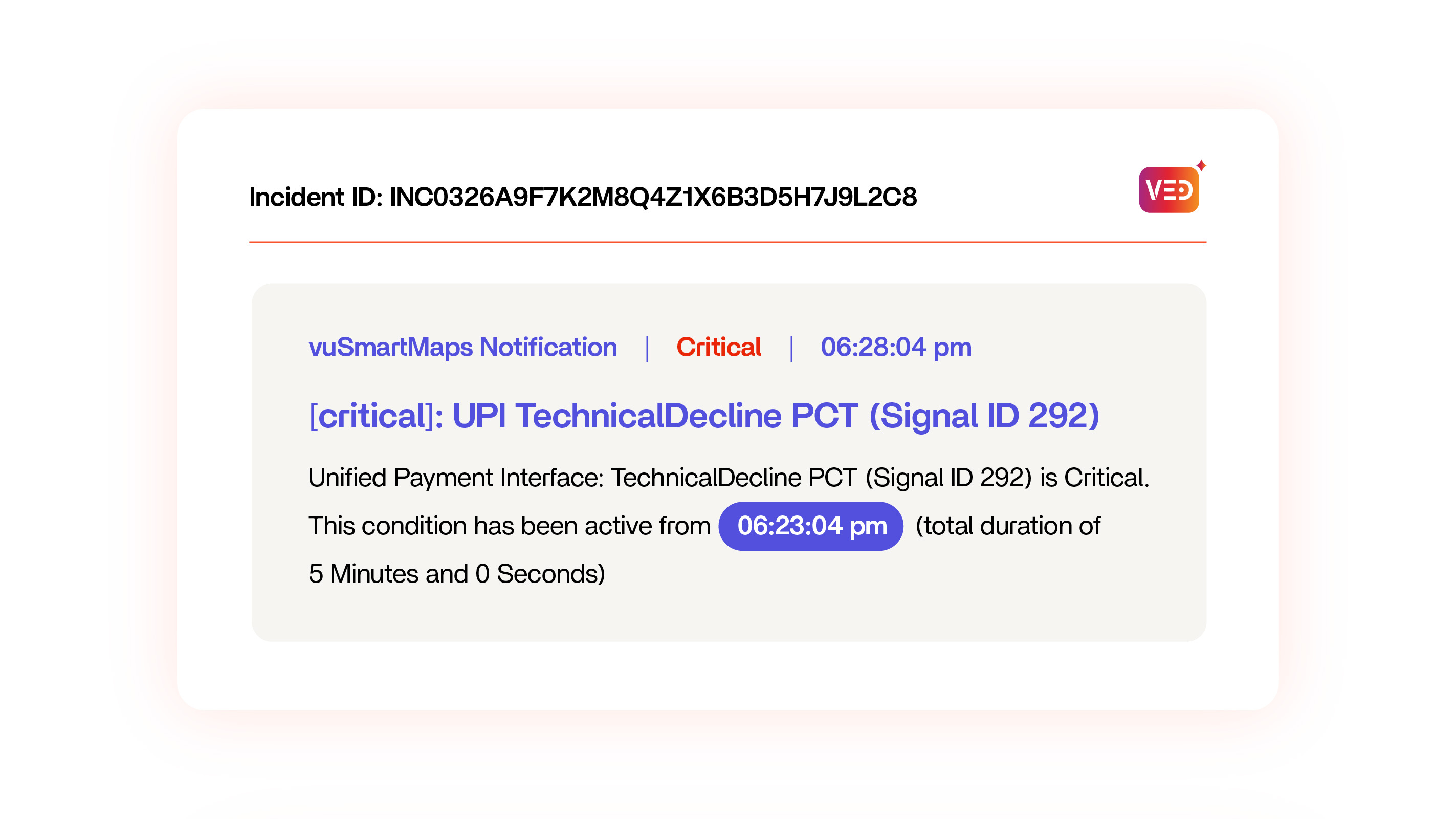
Normally, investigating this would mean switching between multiple dashboards, scanning logs, correlating traces, and tracing dependencies across services. Instead, Arjun clicks the Ved AI icon next to the incident alert and it opens a chat window with a query pre-populated with details based on the alert.
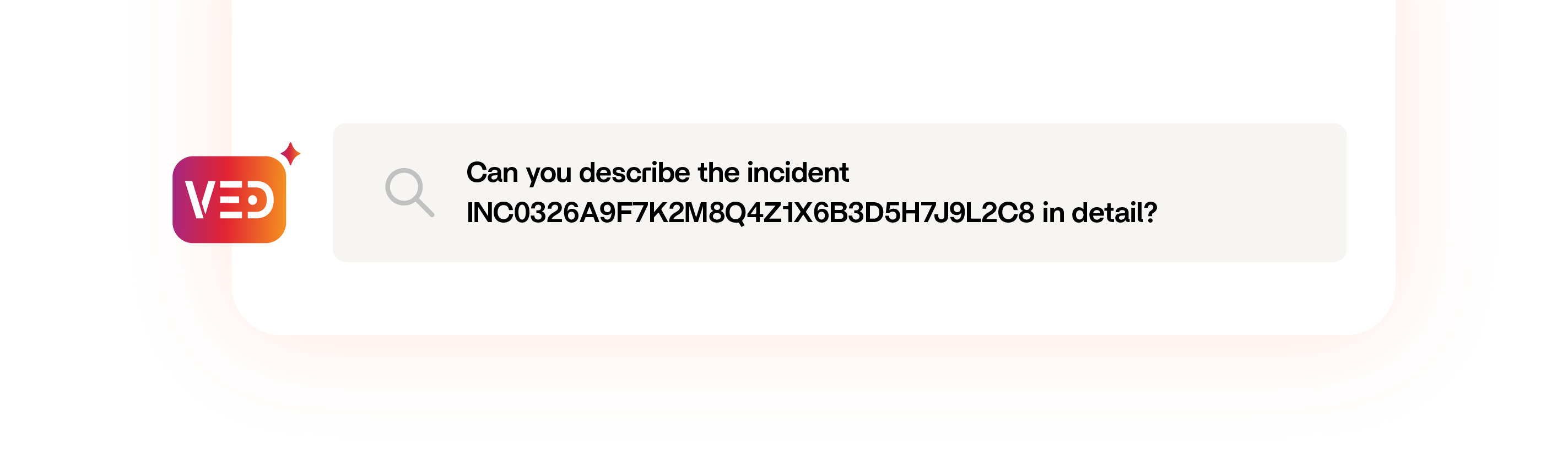
Arjun has the option to modify the pre-populated query or proceed with Ved’s suggested prompt. He continues, and within seconds, Ved streams a detailed analysis of the issue.
- Correlated events across the payment gateway and transaction validation services
- Potential upstream issues - database connection pool saturation
- Impacted business journey: UPI Payment Processing
- Estimated impacted transactions: 18,000 in the last 10 minutes
Ved also provides:
- Root cause analysis
- Operational actions that can be triggered
- Similar historical incidents
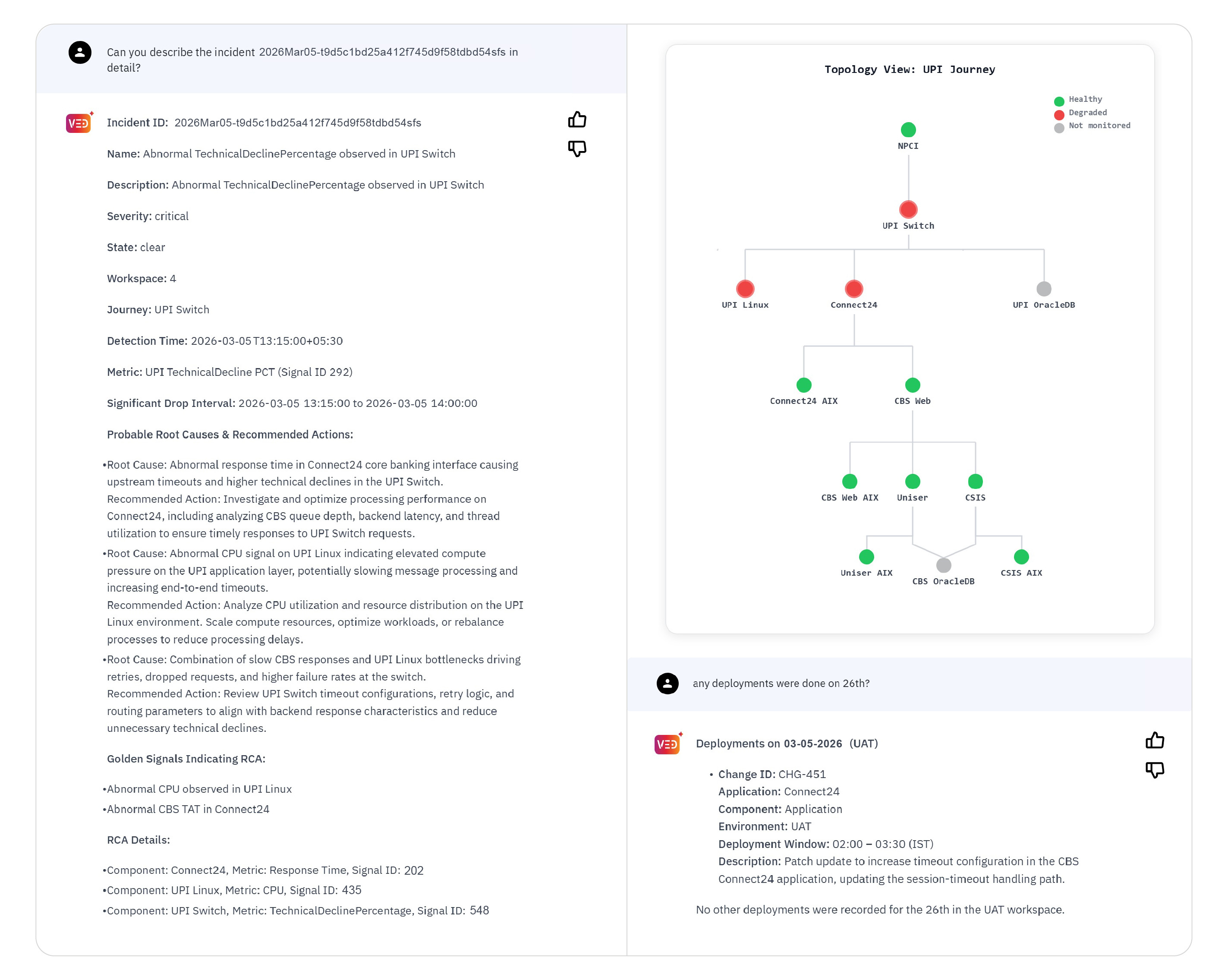
If remediation SOPs or runbooks have been fed to vuSmartMapsTM, VuNet’s observability platform along with other enterprise data, Ved AI can recommend remediation actions such as restarting services or executing scripts.

What would normally take multiple engineers and tools is now resolved through a simple conversation with the observability platform.
Observability becomes conversational. No more
- Switching between multiple dashboards
- Writing complex queries.
- Searching across metrics, events, logs, and traces
- Manually correlating signals across multiple tools
- Translating technical signals into business impact
Introducing the new Ved AI
Modern digital banking systems generate enormous volumes of telemetry data—metrics, logs, traces, and transaction signals. But when something goes wrong, the real challenge isn’t collecting data.
It’s understanding what it means and acting quickly.
VuNet’s Ved AI enables that. It is a Gen AI–powered assistant transforming observability from dashboard-driven workflows to conversational operations. It allows teams to
- Converse with their observability data in a natural language
- Investigate incidents faster
- Understand business impact instantly
- Initiate remediation actions with confidence
All within seconds, effectively reducing MTTD /MTTR
.jpg)
VedAI’s design reflects VuNet’s perspective on how enterprise AI should function. For enterprise operations, AI grounded in enterprise context is the real intelligence.
While integrating large frontier models may appear to be the obvious approach for GenAI assistants, they are not always necessary or effective for enterprise use cases such as AI-driven observability. Trained on vast amounts of internet data, frontier models lack visibility into the operational realities of an enterprise.
They also introduce significant compute and storage overhead, while missing the core requirement for operational decisions - enterprise context.
At VuNet, we believe purpose-built LLMs and SLMs deeply grounded in enterprise context such as incidents, alerts, SOPs, service topology, business KPIs can deliver far more relevant observability intelligence. When deployed on-premise, these models keep data within enterprise boundaries, helping enterprises maintain data sovereignty, regulatory compliance and operational control. Running intelligence closer to where the data resides also ensures faster, context-aware decision-making at the edge for enterprises.
Ved AI has been designed with these principles in mind—contextual and sovereign by design, enabling real-time, context-aware assistance.
Context-Aware Intelligence:
One of VuNet’s biggest differentiators lies in how observability data is processed before it reaches the AI layer.
As telemetry streams via the VuNet platform’s contextual data pipeline , it is automatically enriched with business context, mapping technical signals to:
- Customer journeys
- Business transactions
- Application dependencies
- Operational KPIs
VedAI analyses this context-aware observability data using retrieval-augmented generation (RAG), embedded vector stores and MCP interaction. These mechanisms ensure VedAI responses are continuously grounded in live enterprise knowledge such as incident history, service topology and operational documentation.
When runbooks and SOPs are available, VedAI can analyse them, correlate them with historical incidents and recommend remediation actions.
As a result, when a user queries VedAI, it can instantly connect:
System behaviour → Service dependencies → Business impact
For operations teams, this means moving from technical alerts to business-aware intelligence.
Sovereign By Design:
VedAI is model-agnostic, allowing enterprises to integrate:
- On-premise large language models (LLMs) for sovereign deployments
- Cloud-based LLMs, when data sovereignty is not a constraint
For BFSI enterprises operating under RBI, PCI-DSS, and DPDP regulations, sending observability telemetry — logs, traces, transaction data, incident records — to an external model is both a security and regulatory risk.
With VedAI’s proven ability to work with on-premise LLMs, sensitive data remains secure
- Within enterprise environments
- Within national regulatory boundaries
- Protected from external model exposure
- Compliant with BFSI regulatory expectations.
With Ved AI enterprises can retain full control over which models are used, where they run, and how they are governed. This flexibility enables enterprises to choose the right balance of security, performance, and domain expertise, while maintaining strict data sovereignty and architectural control.
What Ved AI Enables
Observability platforms have traditionally been designed for teams navigating dashboards. Ved AI reimagines this approach. It allows teams to interact with their observability platform in a natural and intuitive way. Here are some of the key ways teams can use it.
Talk To Incidents
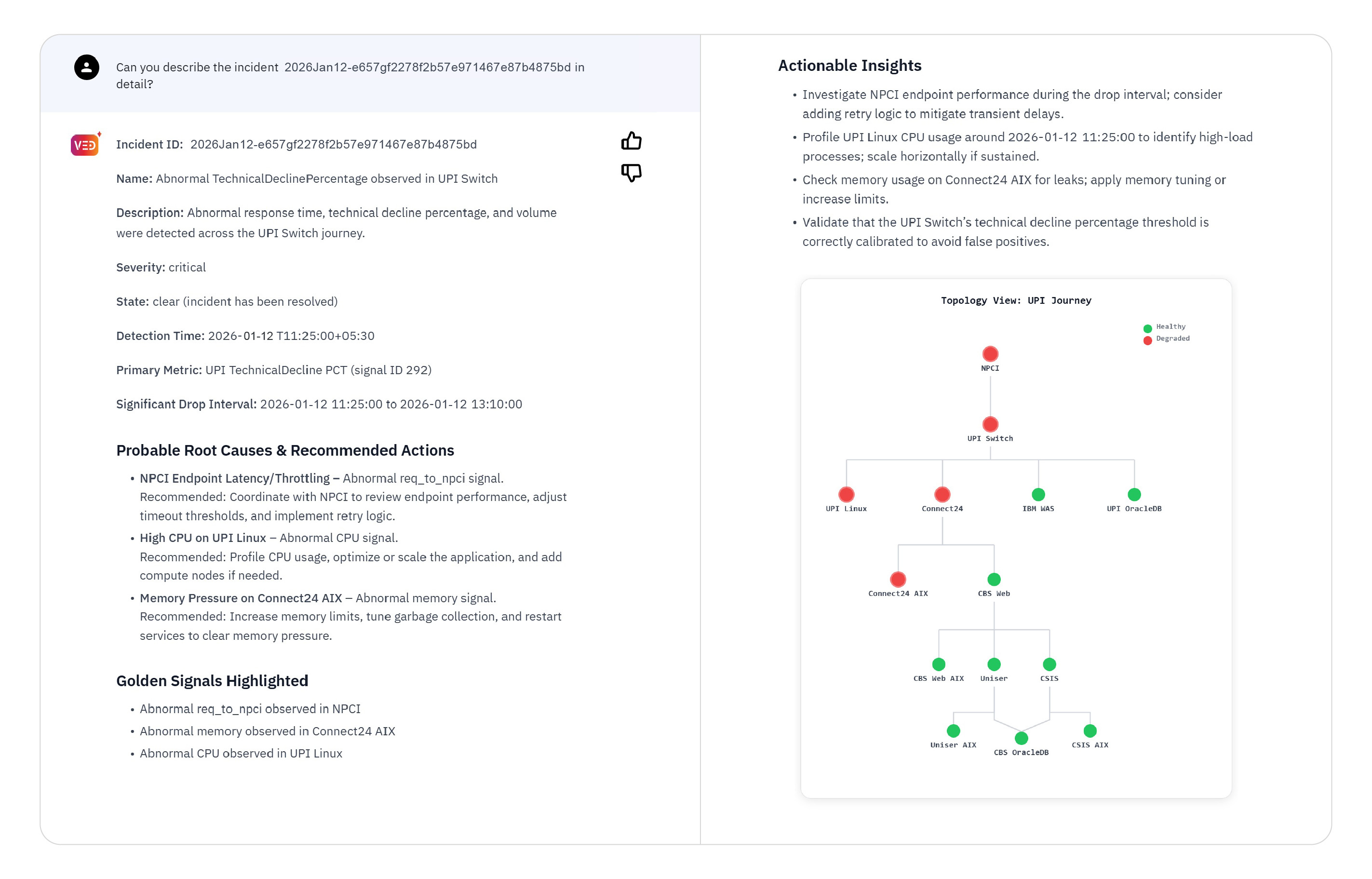
Incident investigations often involve correlating signals across multiple systems. Ved allows a powerful “Talk to Incidents” capability that allows teams to converse directly with incidents.
When an incident is created, users can query Ved AI with the incident ID. Ved then provides a structured response including:
- Incident metadata
- Probable root causes
- Recommended remediation steps
- Correlated events across services
- Topology views showing affected dependencies
This allows engineers to quickly understand what failed, where it failed, and why it failed.
Because Ved operates in a sovereign AI deployment, this analysis happens entirely within the enterprise environment, ensuring sensitive observability data remains protected.
Automated Root Cause Analysis
Ved works alongside VuNet’s automated RCA engine and RCA Bot.
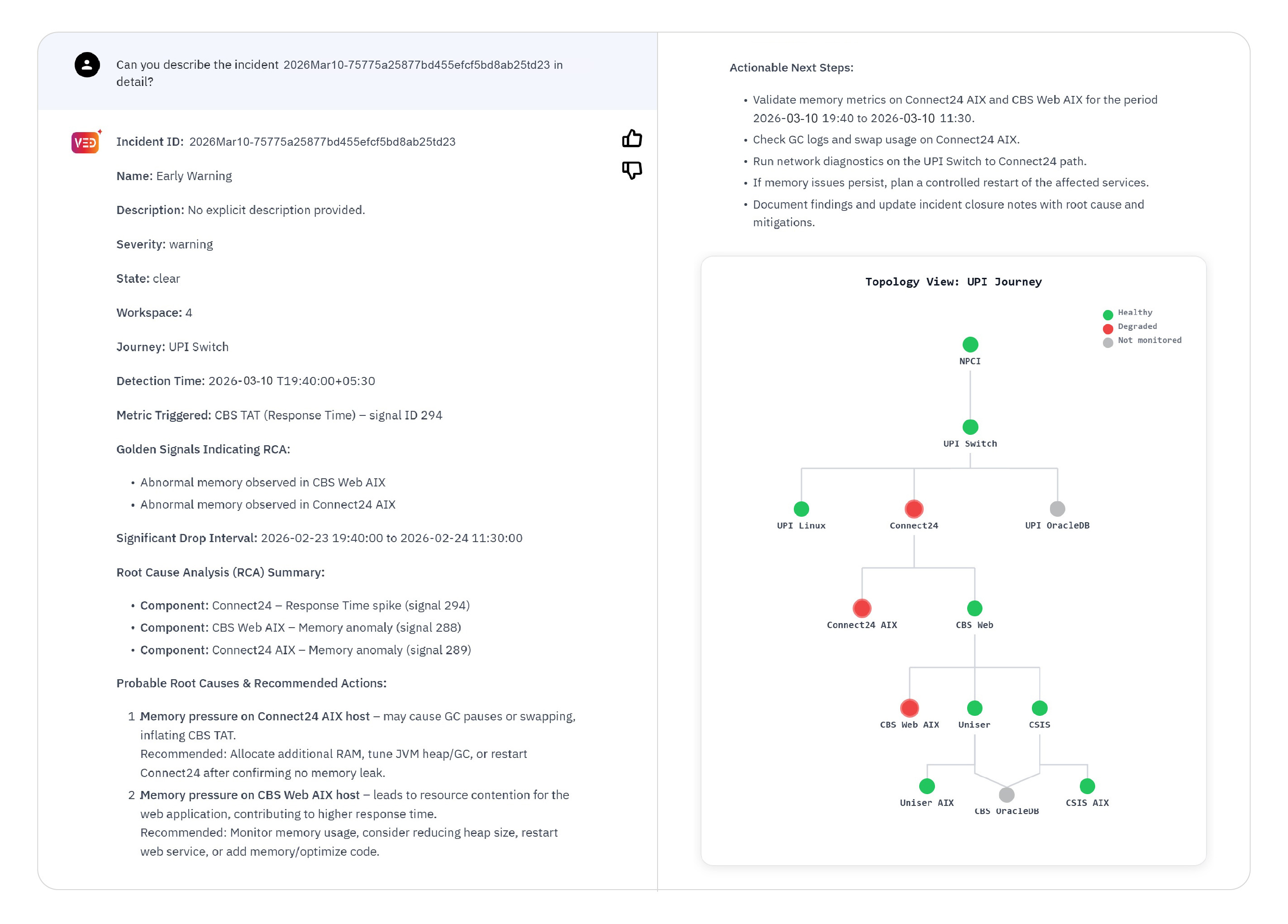
When anomalies or incidents occur, the platform automatically analyzes telemetry signals across services and dependencies to identify potential root causes.
These insights can be consumed in two ways:
- Push-based: Root cause analysis and recommendations can be pushed to vuSmartMapsTM observability platform dashboards via the RCA Bot
- Pull-based: Users can query Ved to investigate incidents and retrieve detailed root cause analysis on demand.
So, when teams query the cause of an incident, Ved can instantly surface the automated RCA analysis along with recommended next steps. This significantly reduces MTTD / MTTR.
Operational Insights
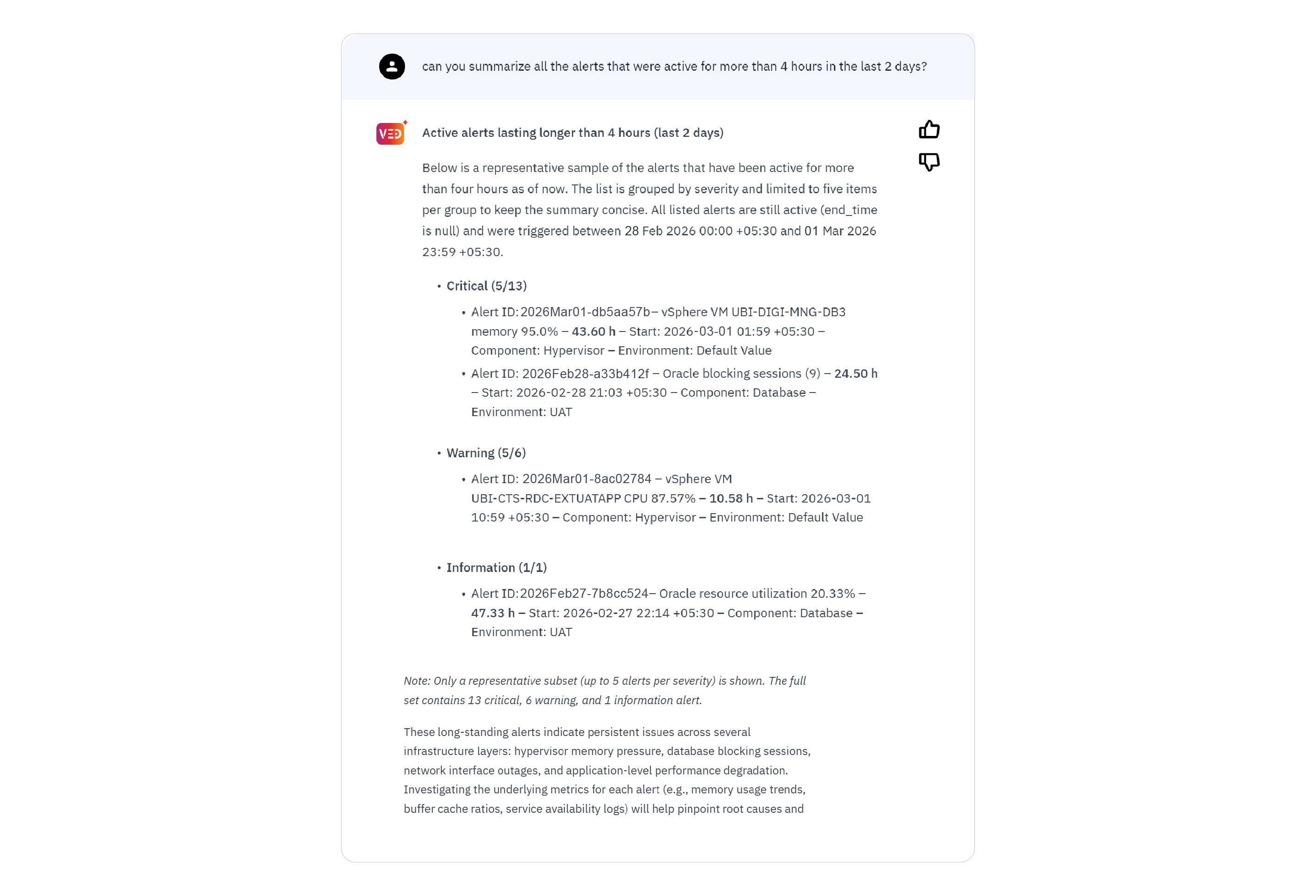
Ved AI can analyze recent operational alerts to provide proactive operational insights. Instead of manually reviewing alerts across dashboards, teams can simply ask Ved questions such as:
"What alerts were triggered in the last 24 hours?"
"Are there any recurring alerts affecting payment services?"
"Show alerts categorized by severity."
Ved analyzes the alerts and provides a structured summary that may include:
- Alerts categorized by critical, warning, and informational severity
- Recurring alert patterns across services
- Similar alerts observed in the past
- Potential causes and recommended remediation
Ask Anything About Your Observability Data
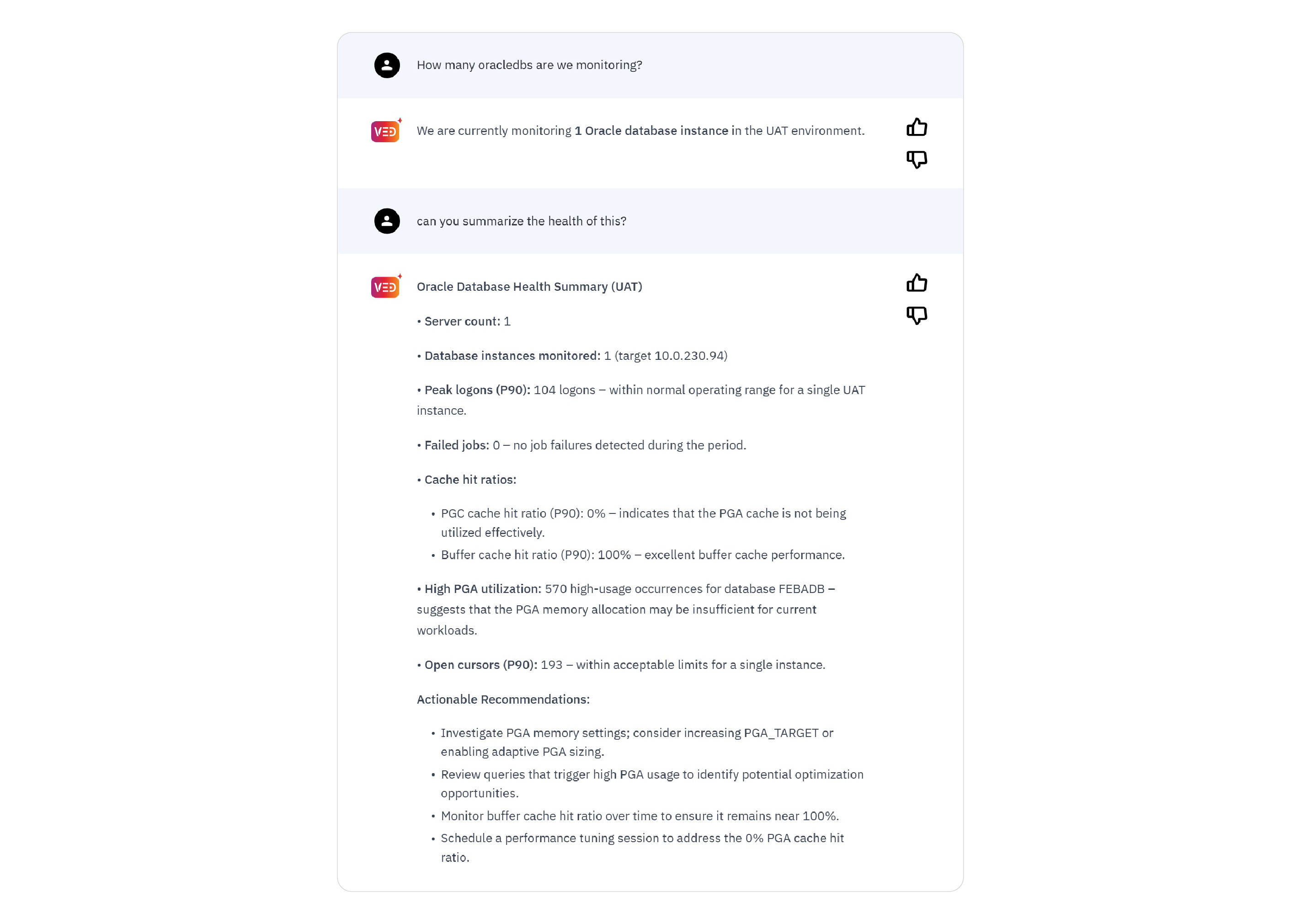
Insights into telemetry data require deep, complex queries. Ved enables multiple personas to retrieve these insights simply by asking questions.
For Example:
- SREs: “Why are payment transactions failing now?”
- DevOps: “Which services have the highest latency right now?”
- Database Team: “Show database performance trends for the last 7 days”
- Business Operations: “Which customer journeys are impacted?”
- Customer Support: “Are there any active incidents affecting mobile banking users right now?”
- Compliance Teams: “Show transaction anomalies or unusual failure patterns in the last 24 hours.”
Ved translates natural language queries into complex searches across the observability data to return contextual operational insights. These insights help teams move beyond reactive incident response toward proactive operational improvement.
Teams can download reports Ved generates to support ad-hoc analysis or incident reviews.
Take Action Faster
Understanding an issue is only half the battle. Teams require actions. When a user receives an alert, they can query the alert on Ved AI.
Along with a detailed analysis of the alert, Ved AI can also recommend actions based on
- Similar historical incidents and past learnings
- Enterprise’s operational runbooks and automation workflows if they have been fed into vuSmartMapsTM, along with other enterprise data
Users can initiate action with the recommendations made or in certain situations, vuSmartMapsTM can trigger actions such as::
- Restarting a failed batch job
- Restarting a service or clearing queues
These actions can be configured to follow controlled workflows and approvals, ensuring operational safety.
vuSmartMapsTM integrates with most ITSM platforms to:
- Create incident tickets
- Assign tickets to the right teams
Enabling Conversational Observability for Enterprises
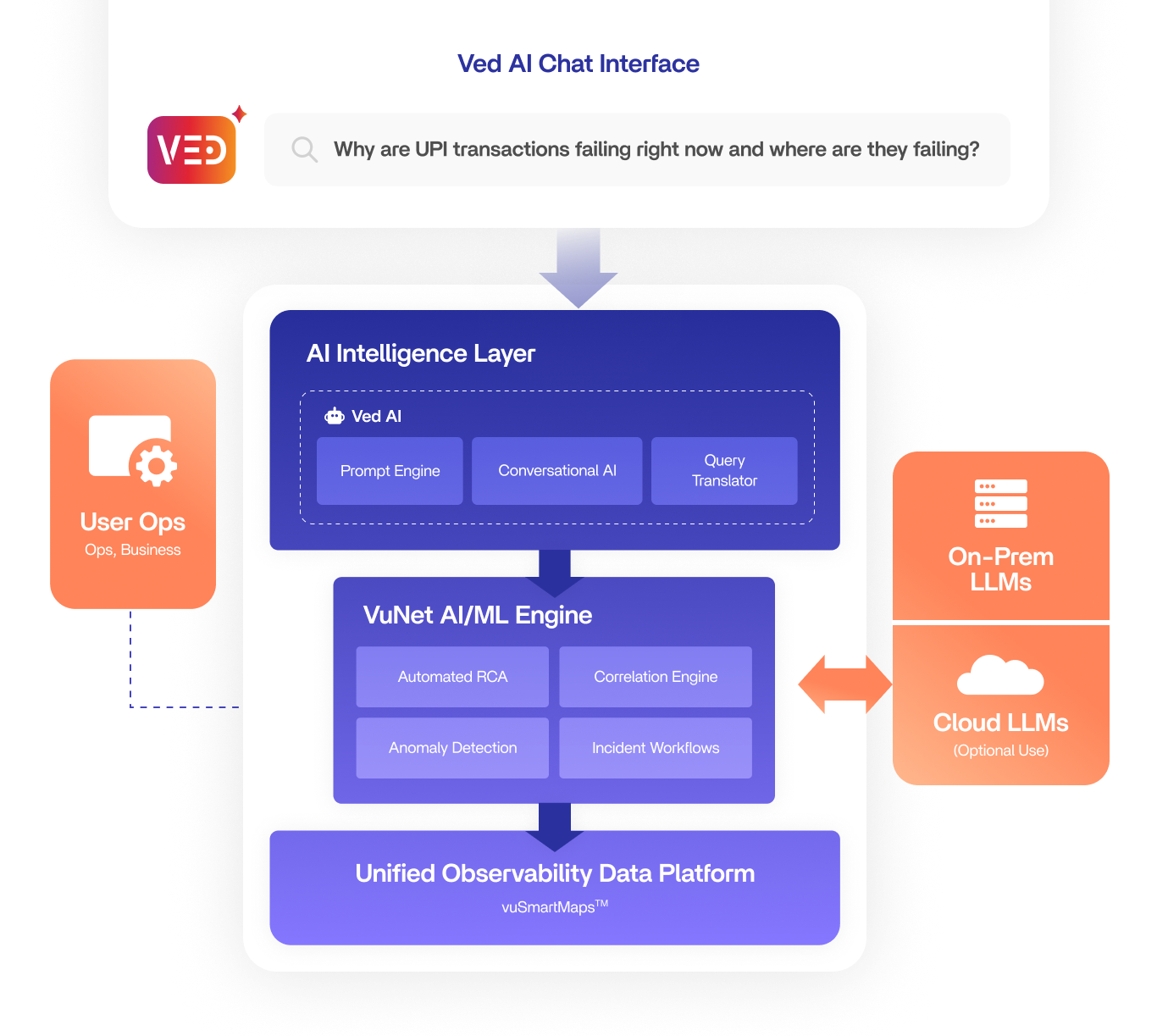
For conversational observability to work effectively, several layers must come together.
- Unified Observability Data Platform
- Telemetry signals are collected and stored in VuNet’s observability platform such as vuSmartMaps™.
- Business Context Enrichment
- Telemetry data are enriched with business context to connect technical signals to business impact and operational KPIs.
- AI Intelligence Layer
- AI/ML engines provide automated RCA with operational recommendations and power Ved.
- Action & Automation Layer
- Integrating runbooks, scripts, and ITSM workflows with the vuSmartMaps™ observability platform, Ved can recommend enterprise-specific remediation actions.
This enables observability platforms to evolve from monitoring systems into intelligent operational assistants.
The Future of Observability Is Conversational
Modern digital systems are too complex for traditional dashboard-driven IT operations. Teams need faster ways to understand incidents, assess business impact, and take action.
Ved AI transforms observability into a conversation-driven experience. All through a simple conversational interface.
With Ved, VuNet’s observability platform vuSmartMaps™ doesn’t just surface data—it converses with you, delivers insights, and helps you act.

