In the BFSI sector, compliance has evolved from a periodic reporting task into a continuous operational governance tied to customer trust, financial stability, systemic risk, and business integrity.
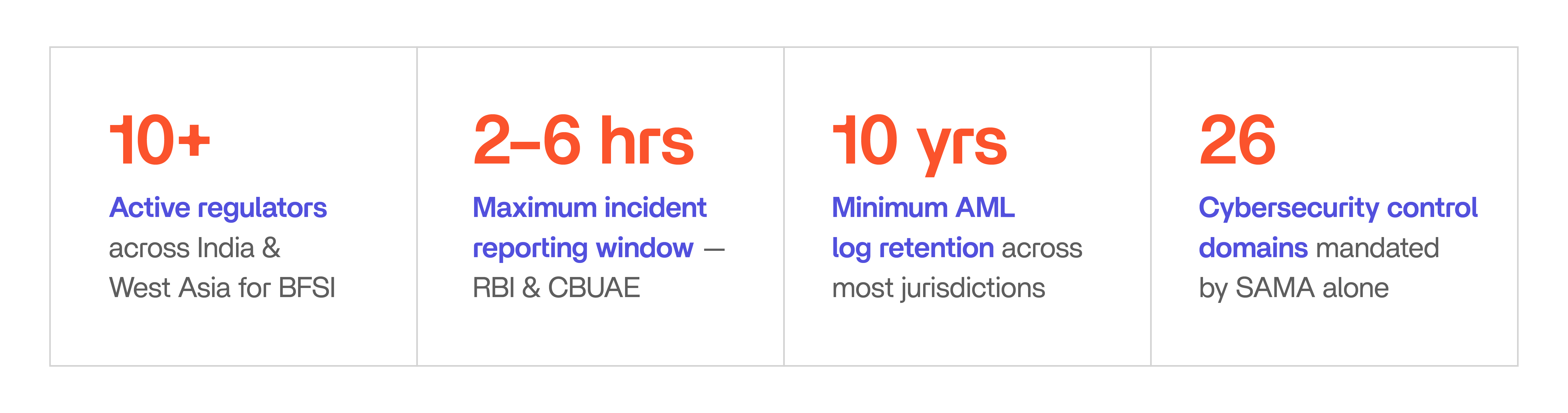
Financial institutions across India and West Asia don't answer to one regulator. Every institution operating across banking, payments, trading, or lending in these jurisdictions is simultaneously accountable to multiple regulators — each with distinct mandates, evidence requirements, and reporting timelines. Every transaction and system event must be traceable, auditable, defensible, retainable, and reportable.
The consequence of falling short is no longer just a fine. It is a licence risk, operational restriction, and public reputational damage that no reporting can undo.
Manually managing compliance is neither built nor effective for this environment. Compliance now requires deep operational visibility.
The Compliance Landscape in BFSI
Regulators like the RBI, SEBI, IRDAI, NPCI, CBUAE, SAMA, and CBB enforce strict mandates to safeguard financial stability, customer protection, and data privacy. These regulators enforce compliance through reporting mandates, audits, inspections, supervisory reviews, and technology governance assessments, often simultaneously and with overlap.
The challenge is not any single regulation. It is the simultaneous overlapping weight of them all that drives the complexity.
The question for BFSI leadership is no longer whether to modernise compliance operations. It is how fast they can do it.
How Business Observability Enables Compliance
The operational complexity of modern BFSI makes compliance structurally hard:
Transactions span dozens of systems and third-party partners; no single team has the full picture
Data volumes run into billions of events daily, and spreadsheets or a disparate set of tools don’t scale
Multiple regulators each demand different evidence in different formats on different timelines. Managing this separately, reactively, becomes time-consuming and expensive.
Compliance requires more context, real-time evidence with transparency and accountability.
Alert fatigue spread across tools may make genuine compliance buried noise and potentially surface after the reporting window is closed.
Business observability addresses each of these. By creating a unified, continuously monitored data foundation across all systems, it enables institutions to:
Trace transactions across distributed systems with the full context regulators expect.
Retain multi-year immutable logs without rehydration delays during audits.
Cover all regulators from one platform, eliminating fragmented tooling that creates evidence gaps and inconsistencies.
Detect SLA breaches and monitor regulatory KPIs in real time.
Reconstruct incidents within minutes to provide operational evidence for regulators.
Generate scheduled regulatory reports automatically, reducing weeks of effort to minutes.
The VuNet Solution: Compliance by Design
VuNet Systems transforms compliance from a reactive obligation into a continuously managed operational discipline, built on three pillars. These three pillars address the three root causes of compliance: data fragmentation, visibility gaps, and manual processes.
1. Regulatory-Grade Data Foundation
VuNet’s Enterprise Data Lake provides unified ingestion for all data types (logs, metrics, events, and traces). It supports
Tiered storage (hot/warm/cold) with blazing fast querying
Multi-year retention (7–10+ years) and high compression, meeting any regulator requirements without a cost explosion
Immutable audit logs ensure data integrity for inspections and regulatory submissions.
Data residency compliant deployment - on-premise or in-country cloud- satisfying RBI, CBUAE, SAMA localisation mandates.
Ensures audit readiness at a sustainable scale without rehydration delays.
2. Business Journey Intelligence
Unlike generic tools, VuNet connects technical signals directly to customer and regulatory impact.
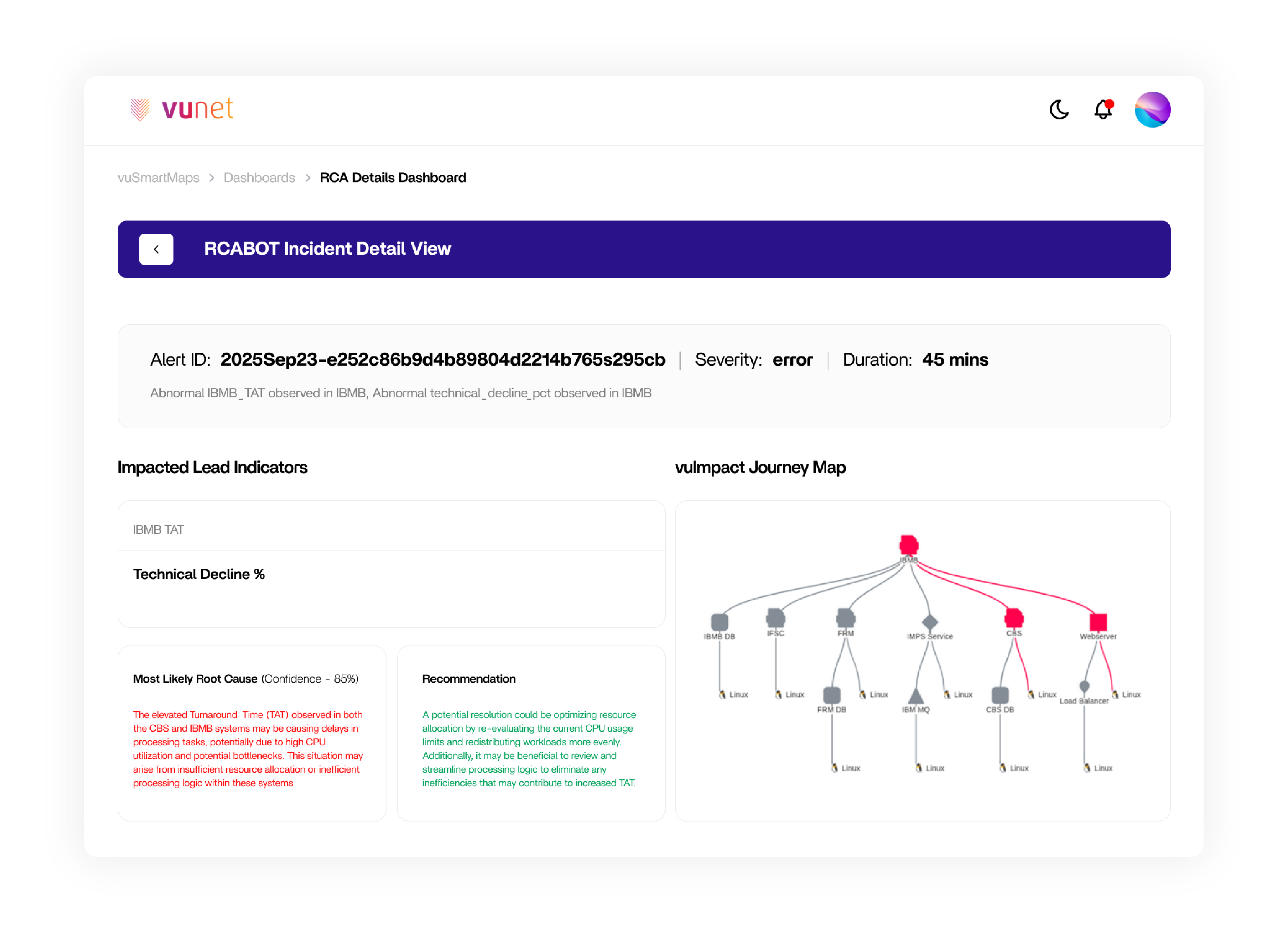
Stitches Journeys: Maps end-to-end transaction flows across multiple systems and partner networks with drill-down to micro-transactions.
End-to-End Defensibility: Pinpoints the exact failure layer (API, Application, Infrastructure, or Partner) with detailed RCA
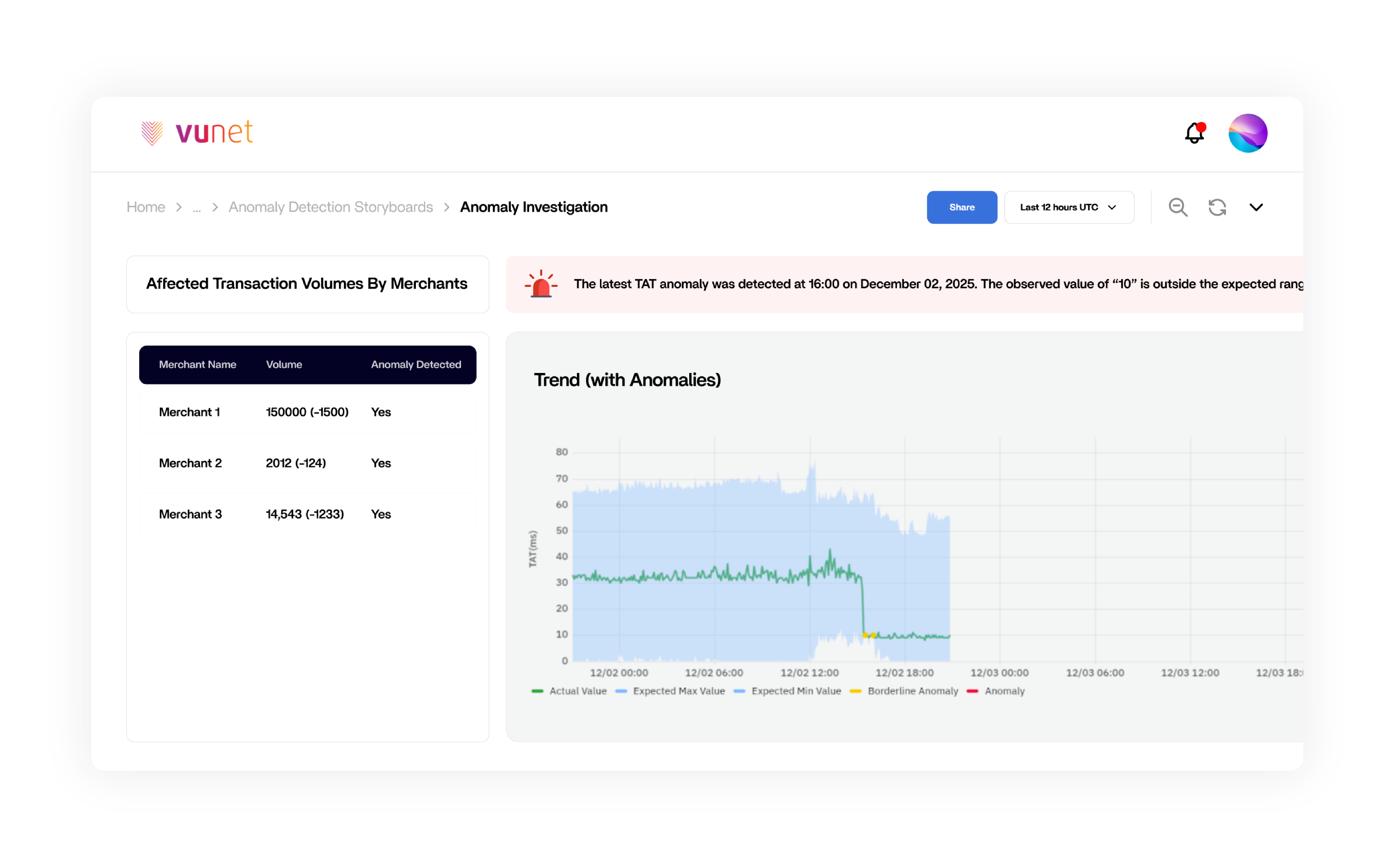
AI-Driven Analysis: Uses predictive intelligence to identify anomalous patterns before they escalate into regulatory breaches.
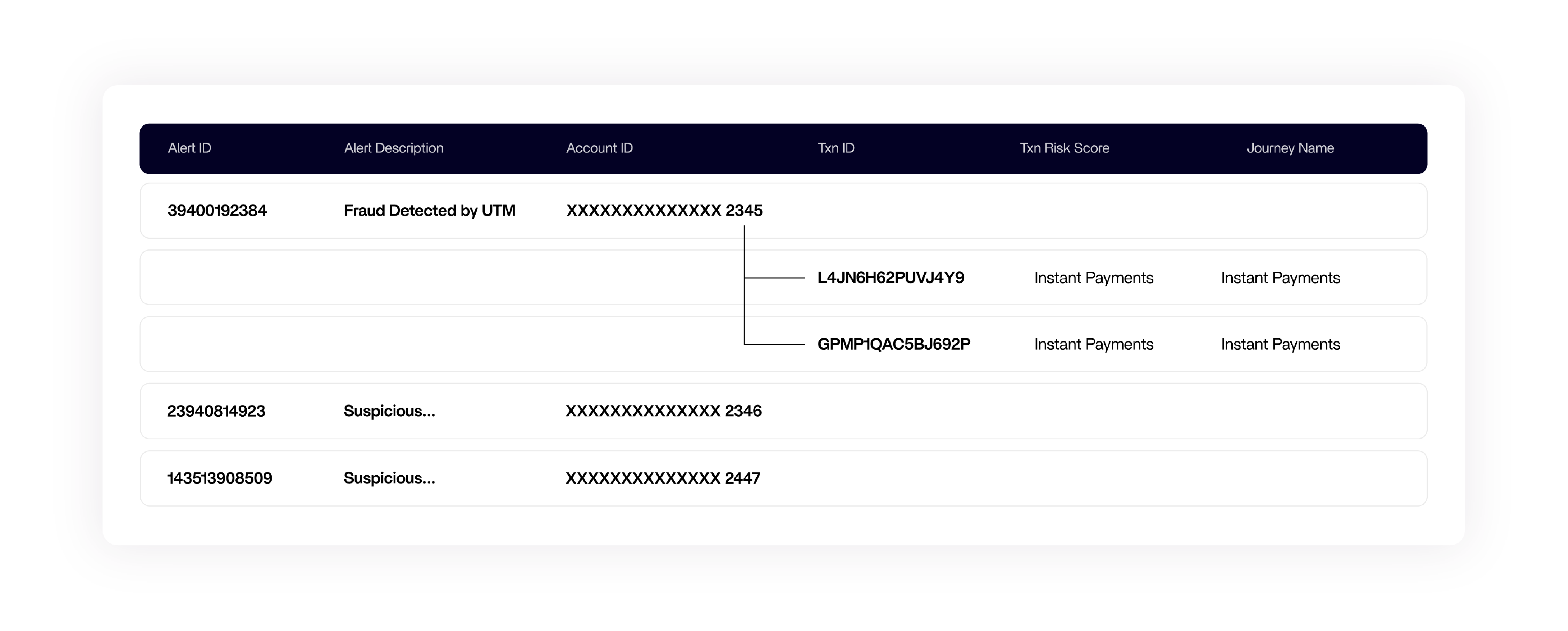
Individual Transaction Search: Search each transaction for AML investigations, dispute resolution, and audit evidence.
3. Automated Governance Workflows
VuNet eliminates manual friction by providing:
Automated Dashboards: Scheduled regulatory reports that turn weeks of preparation into minutes.
AI-Correlated Incident Alerts: Reduces alert noise and fatigue by correlating alerts and reporting with full context
ITSM Integration: Automated ticket creation in any ITSM and ticketing tools such as ServiceNow, JIRA, etc.
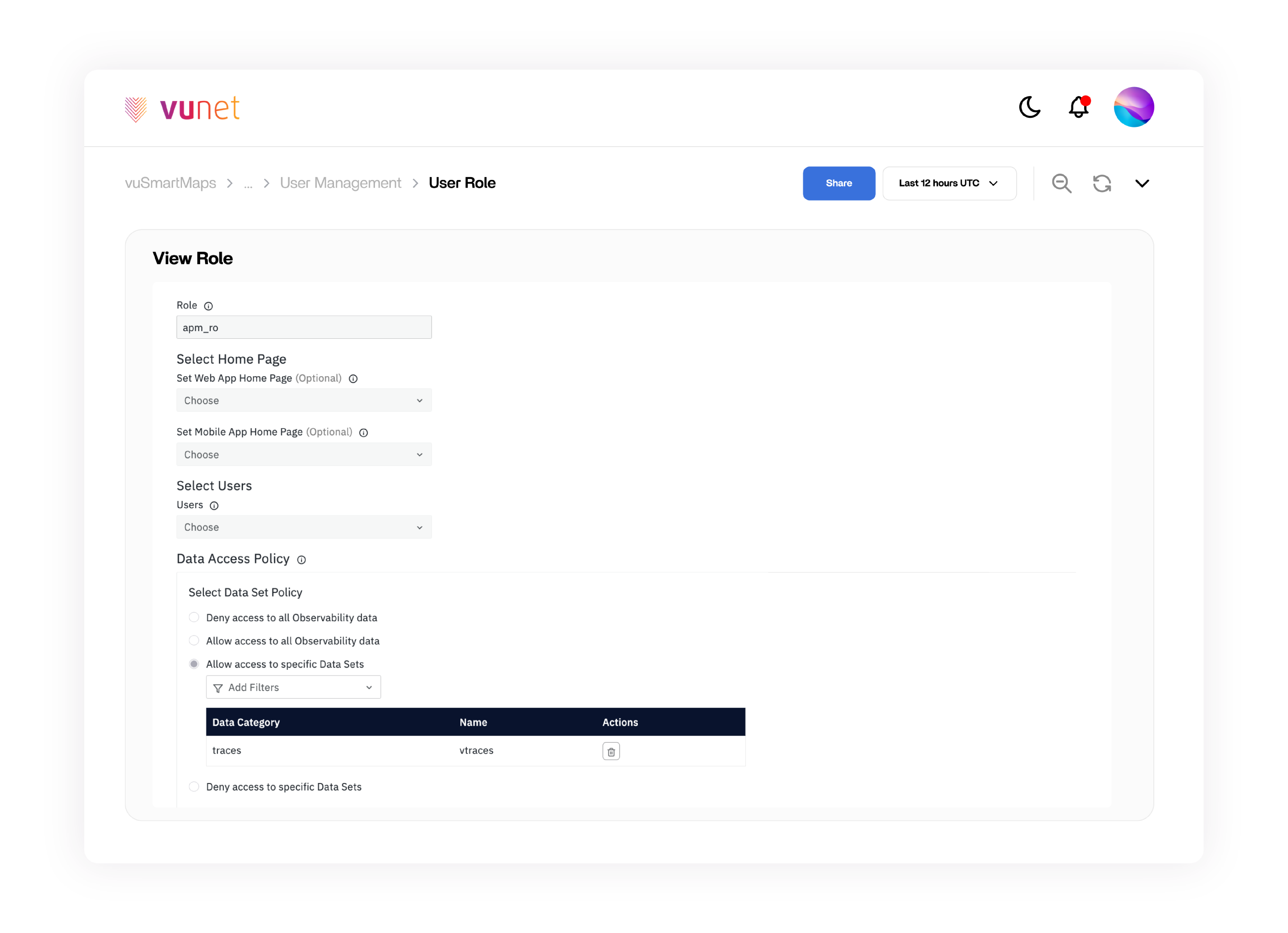
Role-Specific Views: Contextual dashboards for IT, Risk, and Security teams to reduce cross-team friction.
Natural Language Assistance: Teams can query VedAI, VuNet’s GenAI assistant, and ask compliance questions in plain English.
Most enterprises still manage compliance manually. VuNet’s platform changes that - it makes compliance reporting unified, proactive, and automated.
Compliance Factor
The Traditional Challenge
VuNet Advantage
Audit Readiness
Crisis management exercise involving manual log stitching and spreadsheets.
Continuous Audit-Readiness via a unified, regulatory-grade data lake.
Incident Reporting
Difficulty meeting 2–6 hour windows due to "noise" and fragmented tools.
Accelerated Reporting using AI-correlated alerts and auto-incident creation
Data Retention
High costs and "rehydration" delays for multi-year log access.
Tiered Storage (Hot/Cold), ensuring instant queryability of 7–10+ year logs
Traceability
Slower root-cause analysis across distributed system silos.
Journey Intelligence provides end-to-end transaction visibility and defensibility.
Governance
Manual reporting is prone to human error and cross-team friction.
Automated Workflows with role-specific dashboards and immutable audit logs.
Critical Compliance Requirements: India & West Asia
The table below maps the most critical regulatory requirements across India and West Asia (UAE, Saudi Arabia, Bahrain, and Qatar) to specific VuNet capabilities.
Regulator / Framework
Critical Requirement
Why It's Critical
How VuNet Meets It
INDIA - RBI · SEBI · IRDAI · FIU-IND · MeitY (DPDP)
RBI — Cybersecurity Framework
SIEM / SOC with 24×7 real-time monitoring; incident reporting within 2–6 hours of breach
Failure to detect & report in time triggers RBI penalties, operational restrictions, and public disclosure
Real-time anomaly detection across infra, apps & transactions. AI-correlated alerts reduce noise. Auto-incident creation and full context reporting
RBI — Data Localisation (Payments)
All payment data of Indian customers must be stored and processed exclusively within India.
Non-compliance risks RBI audit findings, service suspension and mandatory data migration at scale.
On-premise and India-region cloud deployment. Observability pipelines (logs, traces, metrics) never route outside approved data boundaries.
RBI — IT Framework 2023
Comprehensive log management; IS audit readiness; patch and change management trails
Audit gaps directly leading to RBI inspection findings with mandated remediation timelines
Immutable audit logs across all systems. Tamper-proof log retention with scheduled IS audit–ready reports.
RBI — Account Aggregator Framework
Every consent artefact and data fetch must be immutably logged and end-to-end traceable.
Consent audit failures expose institutions to RBI enforcement and customer litigation.
End-to-end journey stitching maps each AA data request across systems. Immutable consent event logs with full traceability from consent to data delivery.
SEBI can restrict trading operations and impose fines for cybersecurity control failures
Continuous monitoring across trading and settlement infrastructure. 5–10 year tiered log retention (hot/warm/cold). Automated event correlation.
SEBI — Algo Trading
Complete audit trail of every algorithmic order: latency logs, order lifecycle, execution trace
Missing algo audit trails results in immediate SEBI show-cause; can invalidate trades and trigger market surveillance review.
Micro-transaction tracing. Full order lifecycle captured from placement to settlement. Latency KPIs and anomaly detection on order patterns.
FIU-IND — PMLA
Continuous transaction monitoring for AML; STR filing with FIU-IND; 10-year record retention
AML lapses carry criminal liability for senior management, not just institutional fines
Real-time transaction velocity checks and pattern anomaly detection. Full 10-year retention in cold tier.
MeitY — DPDP Act 2023
Consent-based data processing logs; data breach notification within prescribed timelines; lawful basis audit trail
DPDP Board can impose penalties up to ₹250 crore per breach incident
Data access and processing audit trails across all systems. Breach detection with automated alerting. Consent event logging is searchable with VuNet’s querying language (VQL).
IRDAI — Cybersecurity Guidelines 2023
Annual IS audit; policyholder data access logging; incident reporting within 24 hours
IRDAI can revoke licences and restrict product launches for cybersecurity non-compliance
Continuous policyholder system monitoring. Access event logs with role-based views. AI anomaly detection feeds 24-hr incident reporting workflows.
UAE - CBUAE · DIFC/DFSA · ADGM
CBUAE — Cybersecurity Framework 2023
SOC capability; log management; incident response; 8-year record retention
CBUAE can suspend banking licences and impose AED multi-million fines for cyber control failures
Full-stack observability. Tiered 8+ year log retention. Automated incident workflows with full forensic context for regulator submission.
CBUAE — AML/CFT (goAML)
Real-time sanctions screening; STR filing via goAML; 8-year transaction record retention
AML failures attract CBUAE enforcement, FATF grey-listing risk, and correspondent banking restrictions
Real-time transaction monitoring with AI-driven anomaly and velocity detection. 8-year cold-tier retention.
DIFC / DFSA — Data Protection Law 2020
Data access logs; breach notification within 72 hours; data subject request audit trails
DFSA-regulated firms face fines and regulatory censure, reputational risk in a hub financial centre.
Access audit logs with VQL search. Configure custom notifications, such as 72-hr notification workflows.
CBUAE — Cloud Computing Guidance
Critical data residency within the UAE; right to audit cloud providers; no data exfiltration
Breaching data residency in the UAE attracts CBUAE investigation and mandatory data repatriation.
Sovereign deployment option. Observability pipelines completely contained within approved boundaries. Vendor audit-readiness reports on demand.
SAUDI ARABIA - SAMA · NCA
SAMA — Cybersecurity Framework (26 Domains)
Log management; security monitoring; vulnerability management; SOC for all licensed entities
SAMA compliance assessments directly affect licence renewal and expansion approvals in KSA
Covers SAMA's monitoring, log management, and incident domains. Pre-built dashboards map to SAMA control evidence requirements.
SAMA — AML/CFT (SAFIU / goAML)
Transaction monitoring systems mandatory; goAML STR reporting; 10-year retention
KSA enforces strict AML with criminal liability. FATF mutual evaluations make STR quality a sovereign risk
Log collection; SIEM; incident management; audit trails for all critical sector entities
NCA ECC compliance is a prerequisite for operating in KSA's critical financial infrastructure
Unified log collection across 500+ sources. SIEM-grade anomaly detection. Audit trail and incident management workflows with ITSM integration.
SAMA — Open Banking Framework
API-level transaction traceability; consent management with audit logs
Open Banking missteps expose institutions to SAMA sanctions and third-party liability
API call tracing end-to-end across partner networks. Consent event logging. Business journey observability stitches open banking flows across systems.
Conclusion: Compliance by Design
As BFSI institutions scale through digital channels and AI-driven services, business observability is no longer just an IT requirement—it is a governance capability. By embedding compliance into the business observability foundation, organizations can operate with confidence in even the most complex, high-velocity financial ecosystems.
VuNet turns compliance from a periodic audit exercise into a continuously monitored, evidence-ready operational discipline — across every regulator, every jurisdiction, every day.