



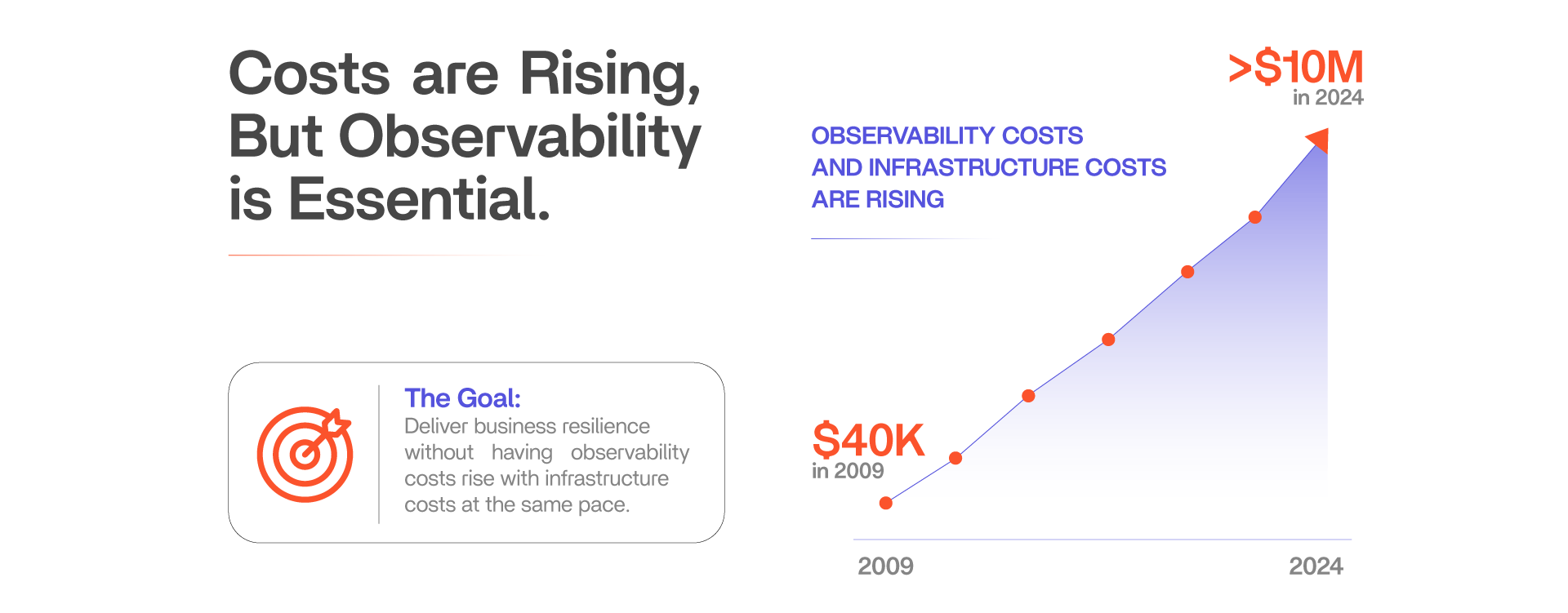
A Gartner customer spent $40,000 on observability in 2009. By 2024, that number crossed $10 million.
Across organizations, observability spend is rising faster than expected.
CXOs are questioning observability investments, the infrastructure required to support them, and the business value they deliver. Avoiding observability to curtail cost cannot be the solution, as it is a critical pillar in the IT ecosystem to ensure continuous availability.
With Digital Transformation across industries, observability has become even more essential for business resilience. Every digital payment, API call, and customer interaction depends on technology working as expected. When something goes wrong, organizations need visibility into the impact on customers, revenue, and compliance.
The key question has shifted from do we need observability to how to scale observability without letting costs grow at the same pace.
Why Observability Costs Keep Increasing
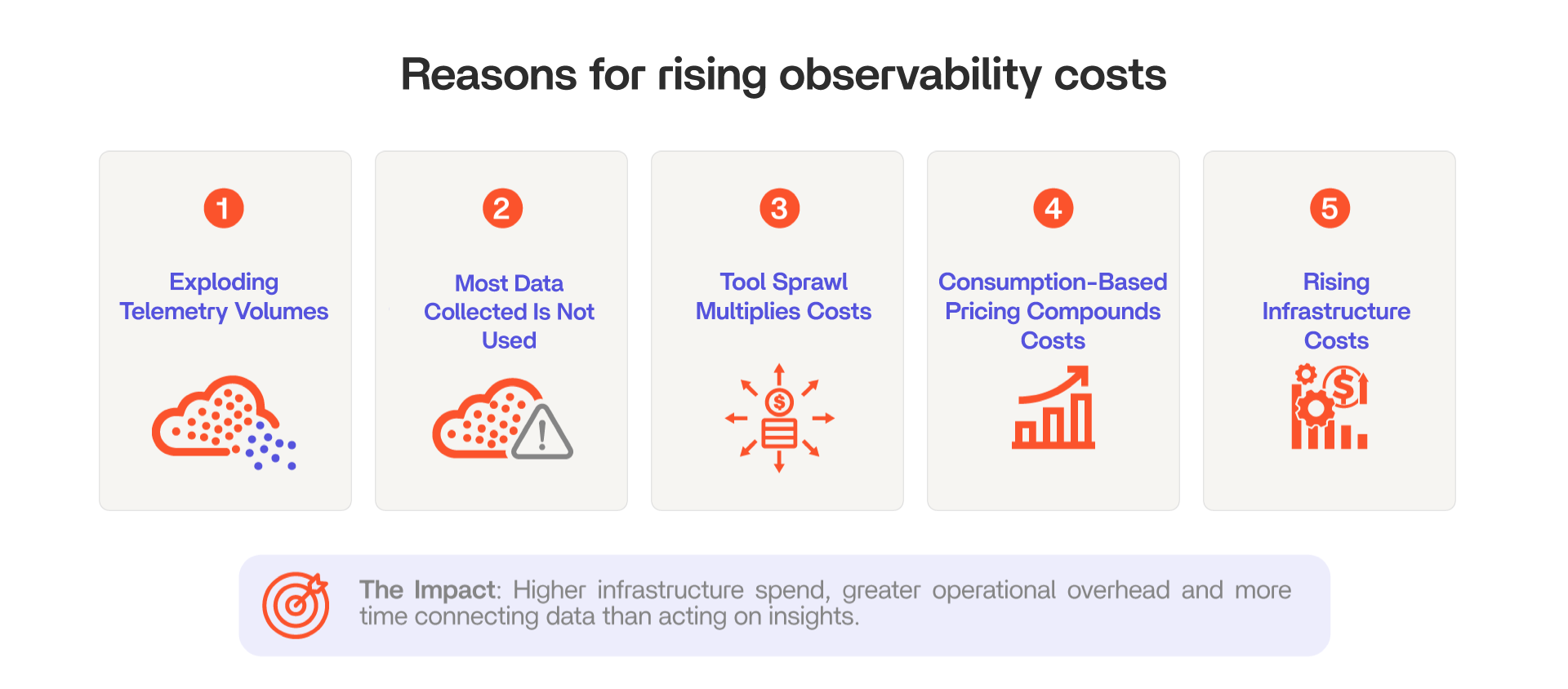
1. Telemetry volumes are exploding
With organizations expanding digital operations, the technology landscape has become more complex. Cloud-native architectures, microservices, APIs, distributed applications, and digital platforms generate logs, metrics, traces, and events at a massive scale.
The rise of Agentic AI applications adds to the complexity. Unlike traditional applications, these systems require visibility across infrastructure, models, user interactions, business outcomes, and security. Gartner predicts that 40% of enterprise applications will incorporate task-specific AI agents by 2026, up from less than 5% in 2025, increasing the data that Agentic AI generates.
As AI adoption grows, so will the observability requirements and with it, the volume of telemetry that organizations need to collect, process, and analyze. In a survey, “The Agentic AI telemetry crisis,” Omdia reports that telemetry growth from Agentic AI is set to increase 9.5x within 2 years, which will further push observability costs.
2. Most of what’s collected is not used
Organizations are storing vast amounts of telemetry, but only a fraction is used for troubleshooting or decision-making.
3. Tool sprawl multiplies the cost
Multiple observability and security tools ingesting and storing overlapping datasets means organizations often pay several times more for the same signal. As telemetry volumes grow and Agentic AI expands, fragmented observability environments make correlation and analysis increasingly difficult. The result is higher infrastructure costs, greater operational overhead, and more effort spent connecting data rather than acting on insights.
4. Consumption-based pricing compounds it
Most observability platforms scale their pricing with data volumes. As telemetry grows, ingestion, retention, indexing, and processing costs grow alongside it, often with little predictability.
5. Infrastructure itself is becoming more expensive
The rapid growth of AI is driving unprecedented demand for memory and compute.
NVIDIA CEO Jensen Huang recently warned that the memory shortage, called RAMageddon by the industry, will last for years to come as manufacturers will prioritize high-bandwidth memory for AI workloads.
For observability teams, that translates directly into higher costs for storing and processing telemetry.
The Market Is Already Responding
The recent acquisition of Chronosphere by Palo Alto Networks is a signal in this direction. A key part of the deal was Chronosphere's ability to deliver cost efficiency through optimized telemetry ingestion and data management.
Gartner has also reported that customers who consolidated tools and implemented better data management practices cut telemetry costs by 30%.
The question organizations are asking has shifted.
It’s no longer, “Do we need observability?”. They are asking, “How do we get the insights we need without paying to store and process everything?”
What Actually Reduces Cost Without Compromising Observability
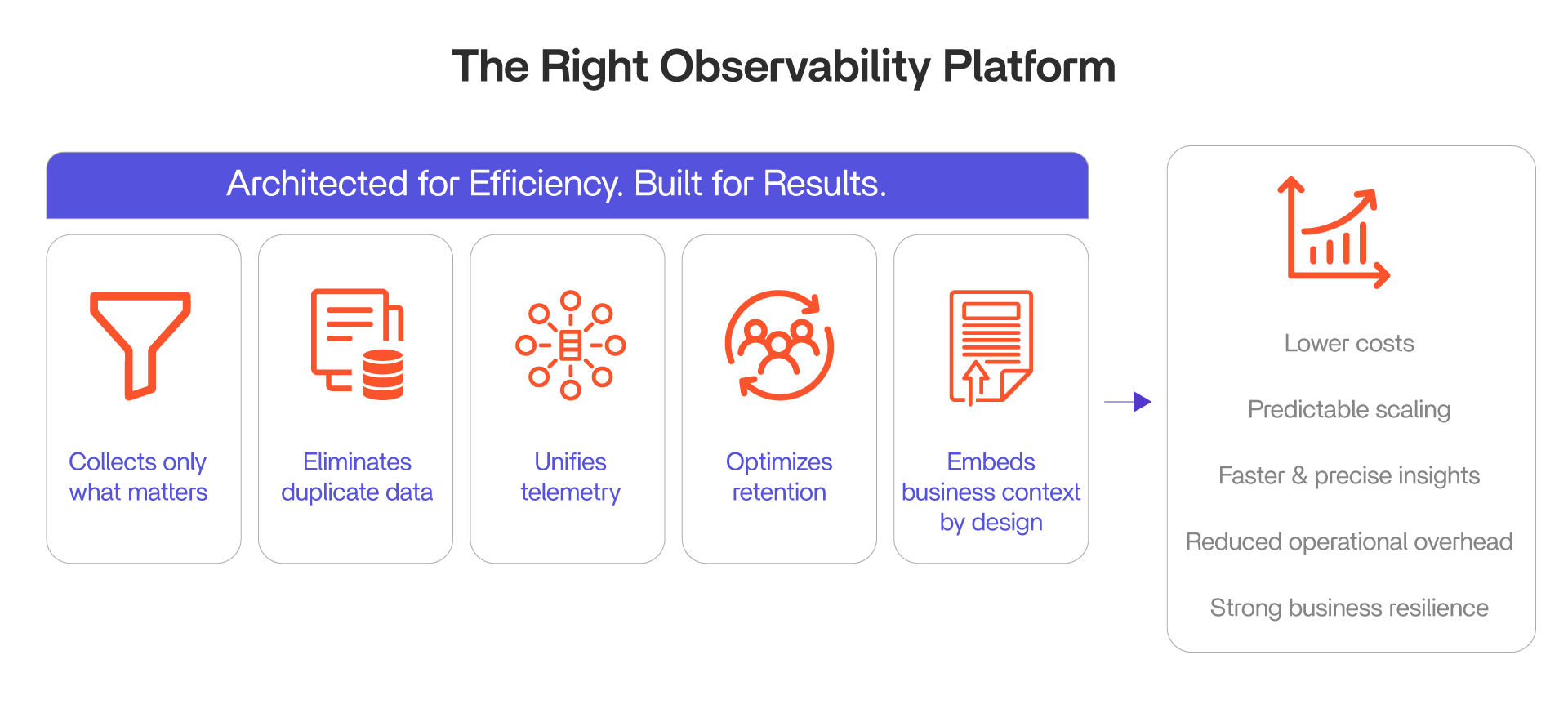
To control observability costs, industry analysts recommend: reduce unnecessary telemetry, eliminate duplicate data collection, optimize retention, consolidate tools, and keep only the data that delivers operational or business value. This helps organizations lower infrastructure costs while reducing the effort required to correlate data and uncover meaningful insights.
But these outcomes cannot be achieved through policies alone. It requires an observability platform that was intentionally designed for efficiency.
The reality is, many observability platforms were built to collect and store at scale. As telemetry grows, so does the underlying infrastructure. More data often means more storage, more compute, and more operational overhead.
To address this, before choosing a platform, organizations should focus not only on features but on the architecture. They should ask:
- Does it eliminate duplicate data storage or add another data silo?
- Can it optimize data retention without sacrificing visibility?
- Does it provide business context without requiring more telemetry?
- Can it scale predictably as transaction volumes grow?
- Can it automatically correlate telemetry without requiring manual investigation across tools?
If the answer to most of these is no, the cost problem isn't going away. It is being deferred.
How VuNet Approaches This: Efficiency by Design, Not as an Afterthought
At VuNet, cost efficiency isn’t a feature. It’s built into the architecture.
Our Business Observability Platform, vuSmartMapsTM, is built on a simple principle: deliver more business insight from the data that matters.
It provides visibility into business transactions, customer journeys, operational resilience, and cyber resilience without escalating infrastructure costs.
What makes this possible:
- Unified Data Lake Architecture: A single foundation that brings together logs, metrics, traces, events, and business telemetry. This eliminates data silos, duplicate storage, tool sprawl, and the need for manual correlation across multiple platforms
- ContextStreamsTM Streaming Pipeline: Removes duplicate data, filters noise, enriches telemetry with context, and processes data in real-time, reducing ingestion, storage and compute costs
- Stream-First, Schema-on-Read Processing: Derives insights as data flows without requiring heavy indexing or pre-processing, lowering infrastructure costs and improving query performance
- Built-in Correlation: Automatically correlates telemetry across sources, reducing manual effort, eliminating noise, and accelerating investigations
- Business-Context Enrichment: Connects telemetry to transactions, customer journeys, services, and business outcomes, helping teams focus on meaningful signals instead of isolated technical events
- High-Compression Storage: Reduces data storage requirements, lowering long-term retention costs while supporting large-scale data growth
- Hot and Cold Data Tiering: Optimizes retention and storage costs by aligning data placement with access and retention requirements
- Built-in Analytics: Eliminates the need for a separate analytics engine and additional processing layers
- Distributed Scale-Out Architecture: Supports predictable growth as telemetry volume increases without requiring expensive infrastructure upgrades or re-platforming
- Sovereign Deployment Options: Provides flexibility to deploy on-premises, private cloud, or public cloud, giving organizations greater control over infrastructure, compliance, and data residency requirements
These architectural choices address both the infrastructure and operational costs of observability at scale.
In independent benchmarking, VuNet's Platform demonstrated:
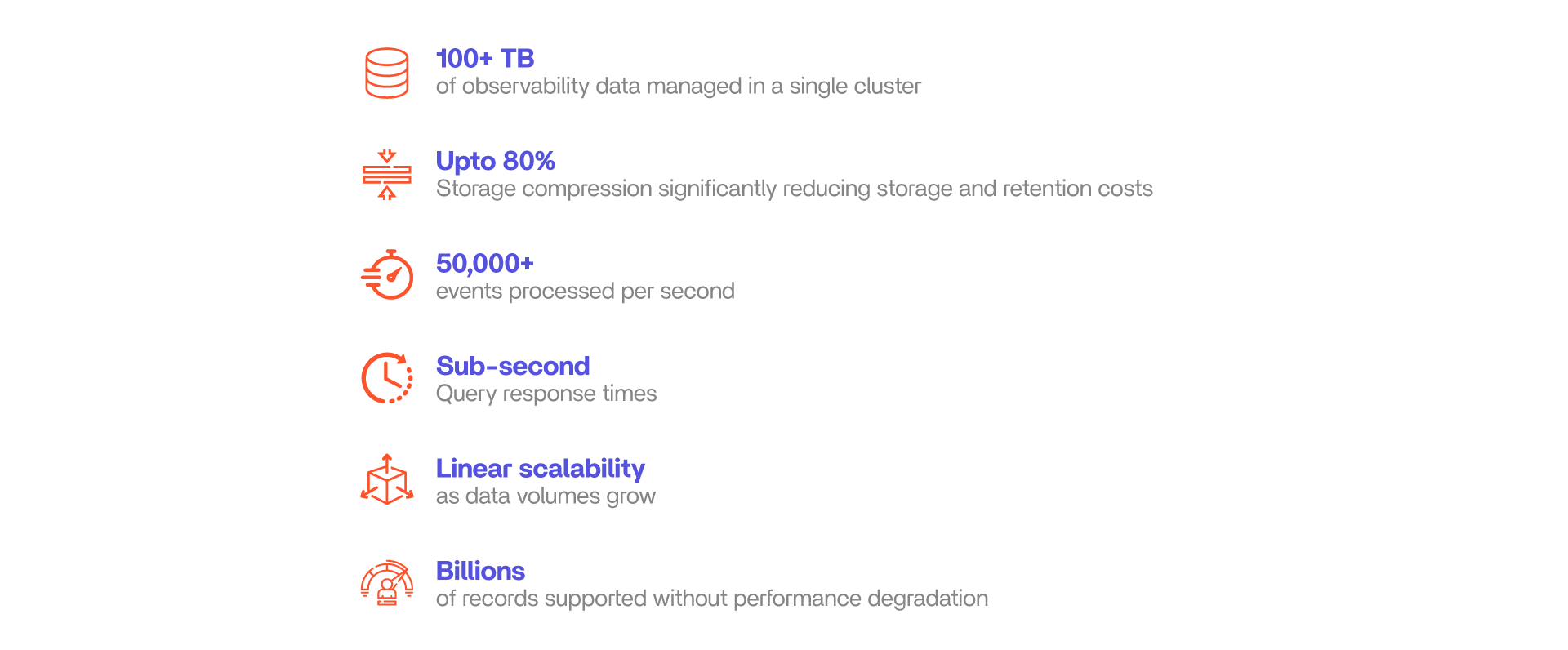
The result is lower storage costs, lower infrastructure overhead, predictable scaling, and sharper business insights.
Final Takeaway
Observability is becoming more expensive as the underlying infrastructure cost continues to rise. Telemetry volumes are rising, AI is driving up infrastructure costs, and CXOs are under pressure to justify every spend.
Instead of cutting observability to drive costs down, the focus must shift towards optimising the use of telemetry within observability platforms. This means organizations need platforms built on the right architectural foundation. The right architecture scales with the business, processes the right data, delivers meaningful insights, and keeps costs predictable without constant infrastructure upgrades or re-engineering.
The organizations that get this right will be the ones that improve visibility and resilience without letting costs grow at the same pace.


