


At 9:00 a.m., customers in one region stop receiving OTPs. IT operations calls the telecom provider. Security receives no alert, and the fraud team sees nothing unusual. By noon, the bank discovers that the disruption was caused by an attack.
This illustrative scenario exposes a gap in how banks respond to incidents.
Security teams protect systems from attacks. Fraud teams investigate suspicious financial activity. IT operations keep services running. Each has its own tools, processes, and dashboards, working in silos even when they are dealing with the same event.
Why banks need a connected view
Attacks can happen across security, fraud, and business. Recent incidents stand as proof of that.
- A security breach that puts customer data at risk. In July 2026, a large bank disclosed that an employee's email account had been compromised and used to access data.
- Leaked data that fuels fraud. In October 2026, India's largest bank found 3,897 customer records with personal details on the dark web. Details like these are what fraudsters use for phishing and account takeover.
- A cyber attack that becomes a business outage. In 2024, ransomware at a technology provider, C-Edge Technologies, cut UPI and ATM access for customers of nearly 300 cooperative and regional rural banks. The banks' own systems were not breached. Their customers were still locked out.
- AI-driven attacks across a sector. In South Korea, hacking incidents hit 16 financial firms, including major banks, where AI agents are suspected.
AI adds another concern. Attackers can use it to find weaknesses and accelerate attacks across `all three areas. And the first sign is often not a security alert. It is a business problem: OTPs not arriving, UPI success rates falling, a sudden spike in customer complaints.
AI is also being used by banks for fraud checks, lending workflows and customer service. If one of these models behaves oddly, say the fraud model suddenly blocks genuine payments, its effect is felt at security, fraud and customer service and teams need to find the cause.
All of this points to one need. Banks need a connected view across security, fraud, business operations and their own AI, so that every team sees the same incident and acts on it together.
Regulators have tightened: Turn compliance into capability
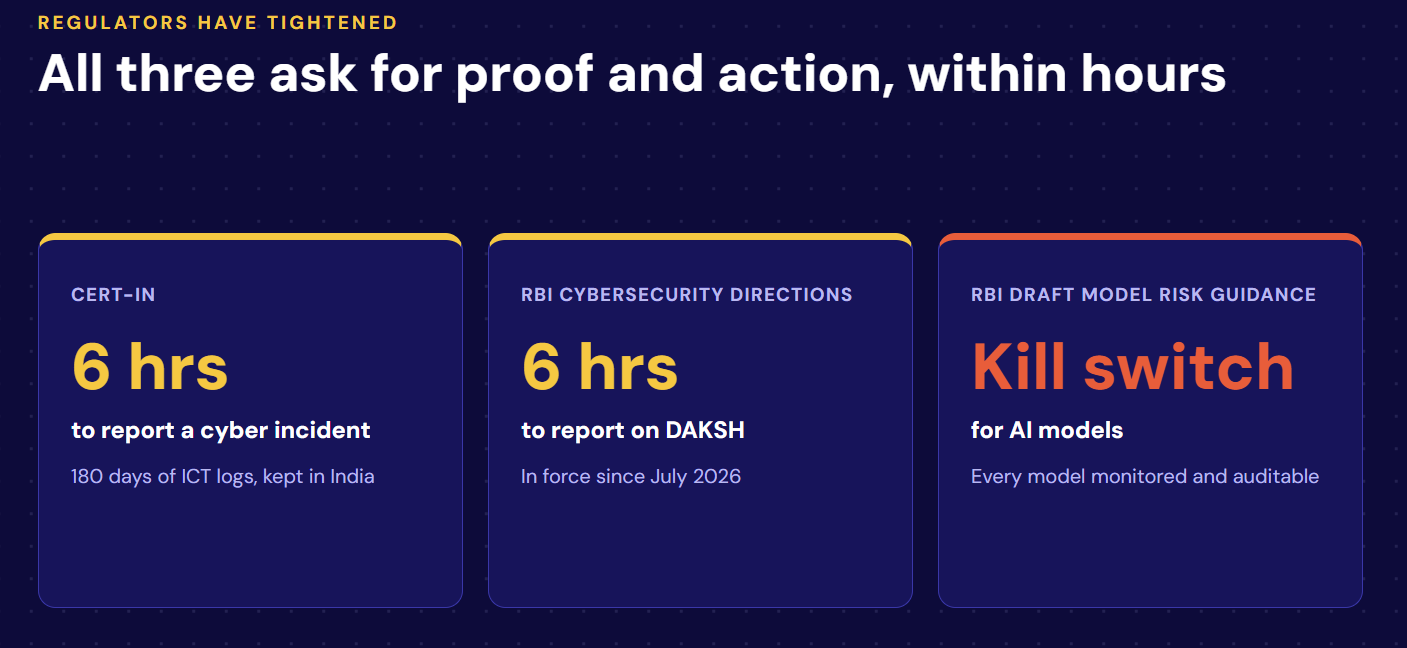
In June, we wrote that RBI's mandates are really about business resilience. The rules have only tightened since in response to the rising cyber threats.
- CERT-In. Report a cyber incident within six hours of noticing it. Keep logs of all ICT systems for a rolling 180 days, within India, and share them when asked.
- RBI's cybersecurity directions (July 2026). Banks must report cyber incidents within six hours of detection on RBI's DAKSH platform, and notify CERT-In.
- RBI's draft guidance on model risk. RBI has proposed that every AI model a bank uses, needs to be monitored, traceable and auditable, with a kill switch to suspend it, if needed.
All three ask for the same thing: proof and action. Banks must be able to show what happened, when it began, what it touched and how they responded, all within hours.
To meet the rules, banks maintain the logs. But what really matters is how quickly they are able to find and use them when something goes wrong across security, fraud and business data.
This leads us to what the banks need to build stronger business resilience against growing cyber attacks.
Four imperatives for banks for stronger cyber resilience
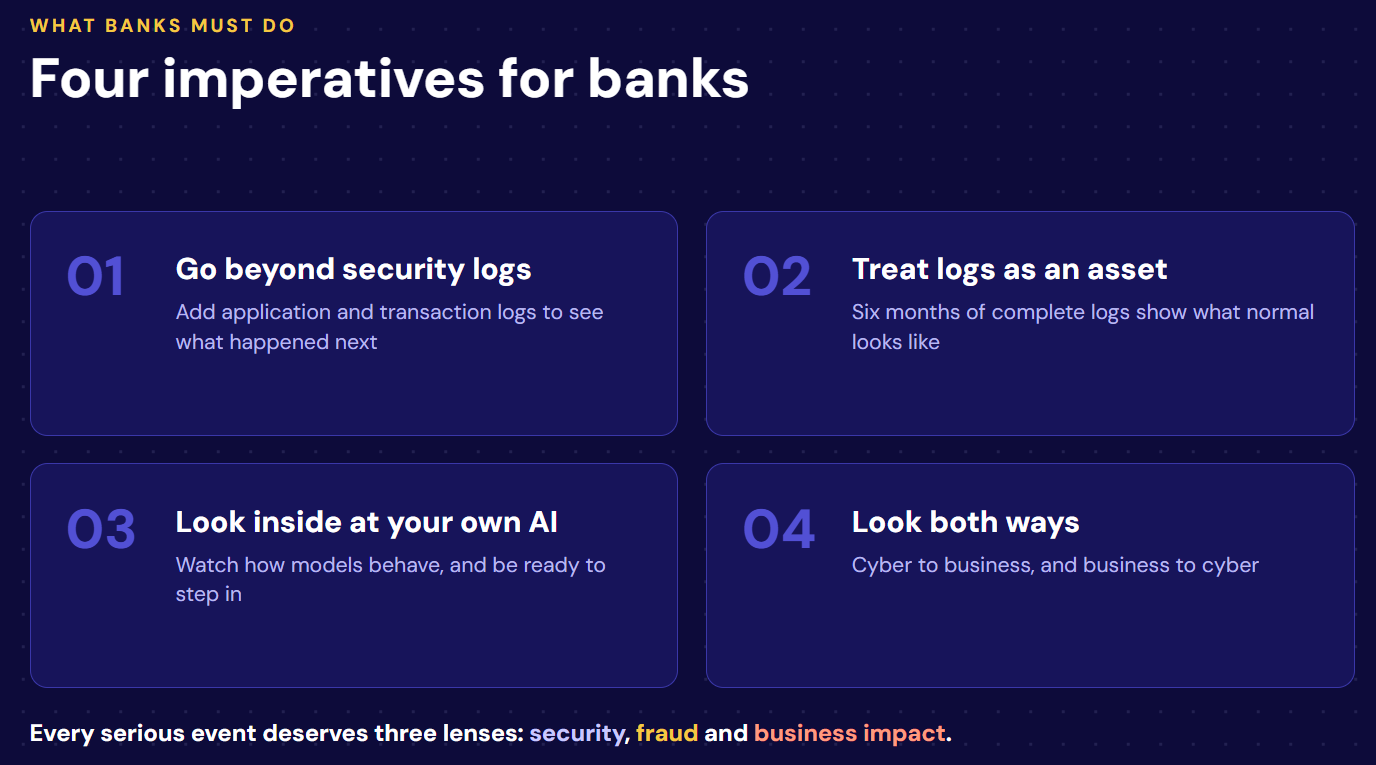
1. Go beyond security logs
Security logs show who connected and what they touched. Application and transaction logs show what happened next.
Consider a login followed by a new beneficiary and a high-value transfer within four minutes. Or a sharp rise in OTP requests without a similar rise in completed logins. Viewed separately, these events may attract little attention. Viewed together, they may warrant investigation for account takeover or OTP abuse.
Banks need a searchable foundation that allows teams to investigate incidents through three interconnected lenses: security, fraud, and business impact.
2. Treat logs as an asset, not a cost
Log storage is often treated as a cost to keep down. As data grow, so do storage and licensing costs across log tools, archives and SIEM platforms, especially where pricing depends on how much data is ingested or retained. So teams may exclude sources, shorten history or delete older logs sooner. Vendor and SaaS logs can create further gaps if access and retention are not agreed upfront.
Banks should know which logs are collected, where they reside and how long they remain available. They should also test how quickly older records can be retrieved.
A log data lake with compressed, tiered storage helps banks preserve a broader searchable record. Relevant data can be sent to the SIEM based on detection and investigation needs.
3. Look inside at your own AI
Banks rely on AI Models to flag fraud, assess loans and answer customers, so they need to be watched like any other critical system. Banks need to see the model’s behaviours and decisions and step in quickly and apply the kill switch when something goes wrong.
4. Look both ways
Most banks look at an incident from one direction only. Security asks whether an attack worked. IT operations asks whether a service is down. Every serious event needs both questions.
From cyber to business. When security detects an attack, the bank needs to establish the business impact. Which journeys are affected? How many transactions are failing? Which services should be prioritised for recovery?
From business to cyber. This direction is less common, and more valuable. When OTP delivery fails or payment success rates fall, teams should check whether suspicious activity is involved. A surge in balance enquiries may be bots scouting for targets. A slow partner API may be scraped by an automated agent.
Together, these mark a shift from isolated security monitoring to combined operational and cyber resilience.
What this needs: Connecting live visibility with searchable history
These four imperatives need two things working together.
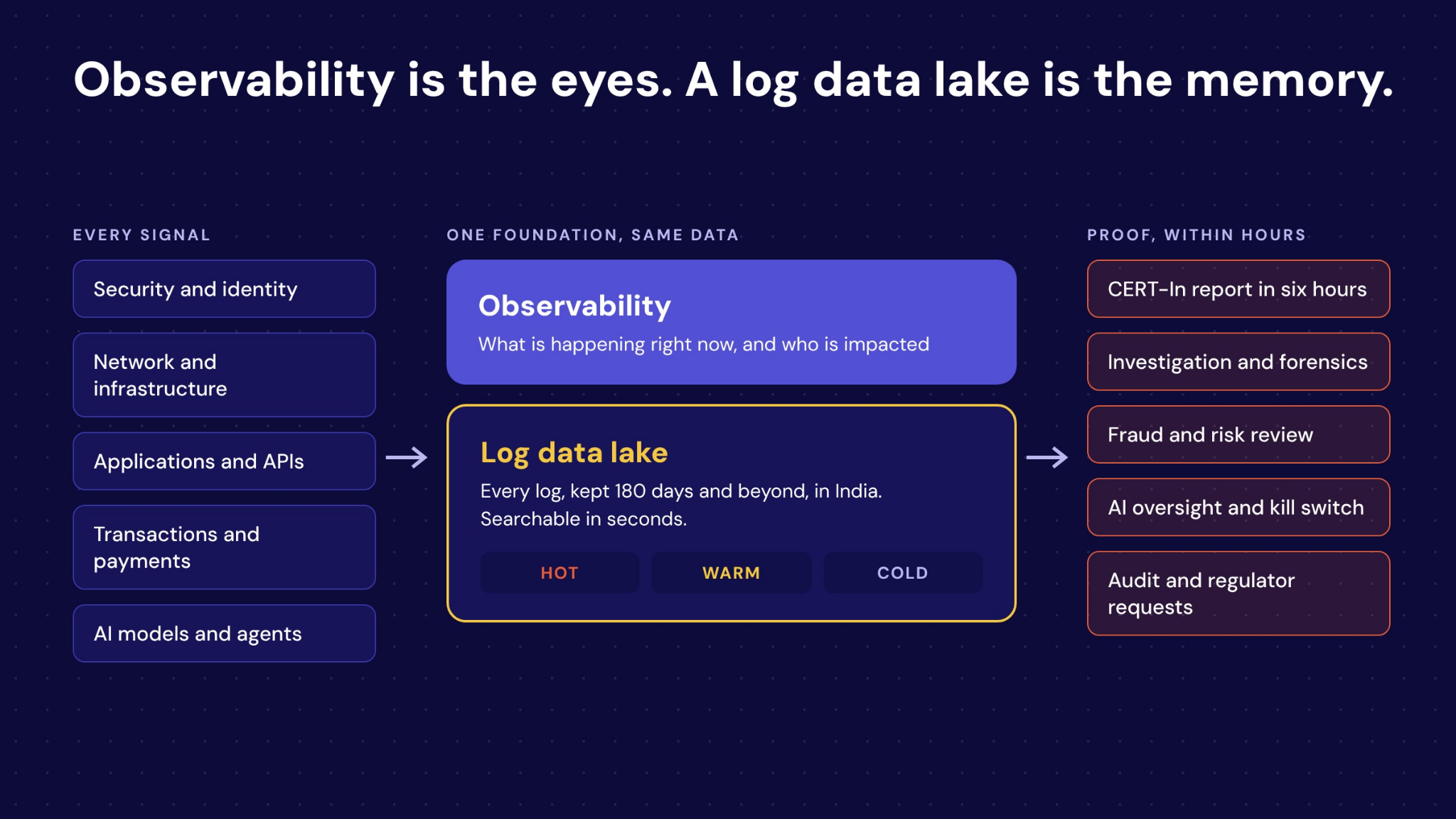
Observability is the eyes. It shows what is happening right now, who is getting impacted,: which journeys are failing, which channel is slow, how many customers are affected. Banks have invested well here, and it remains essential.
A log data lake is the memory. It keeps the history and makes it searchable in seconds. It answers the questions the eyes cannot: When did this start? Who else did this? What did our AI model do last week?
Here is how the two answer each imperative.
1. Every log, connected. The lake brings security, identity, infrastructure, application, API and transaction logs into one governed place. This enables viewing a failed payment as a traceable sequence: authentication, gateway request, switch response, core banking and customer outcome. Security, fraud and IT operations work from the same evidence.
2. Logs as a strategic asset. With compressed, tiered storage, the data lake keeps 180 days and beyond at a predictable cost. Banks no longer have to drop sources to save money. The SIEM gets only what it needs, and the full record stays ready for investigation, operations and audit. The cost of retention becomes an investment in evidence.
3. Understand what your AI did. Observability watches how models behave, and flags drift or odd outputs early. The data lake keeps a record of model versions, inputs, outputs, and human overrides, linked to the transactions they touched. If any odd behaviour is flagged, teams can quickly find the cause and decide to pull the kill switch, if needed.
4. Looking both ways. Observability spots the business symptom: OTPs failing, UPI success falling. The data lake shows whether an attack caused it, by tracing the failing requests back through months of security and access logs. It works the other way too. When security sees an attack, observability shows which customers and journeys it impacted.
What a banking-ready log data lake needs
One architectural response is to establish a unified log data lake that supports security, fraud, and IT operations so each team doesn’t maintain a separate copy of the same data. It should deliver six essential capabilities
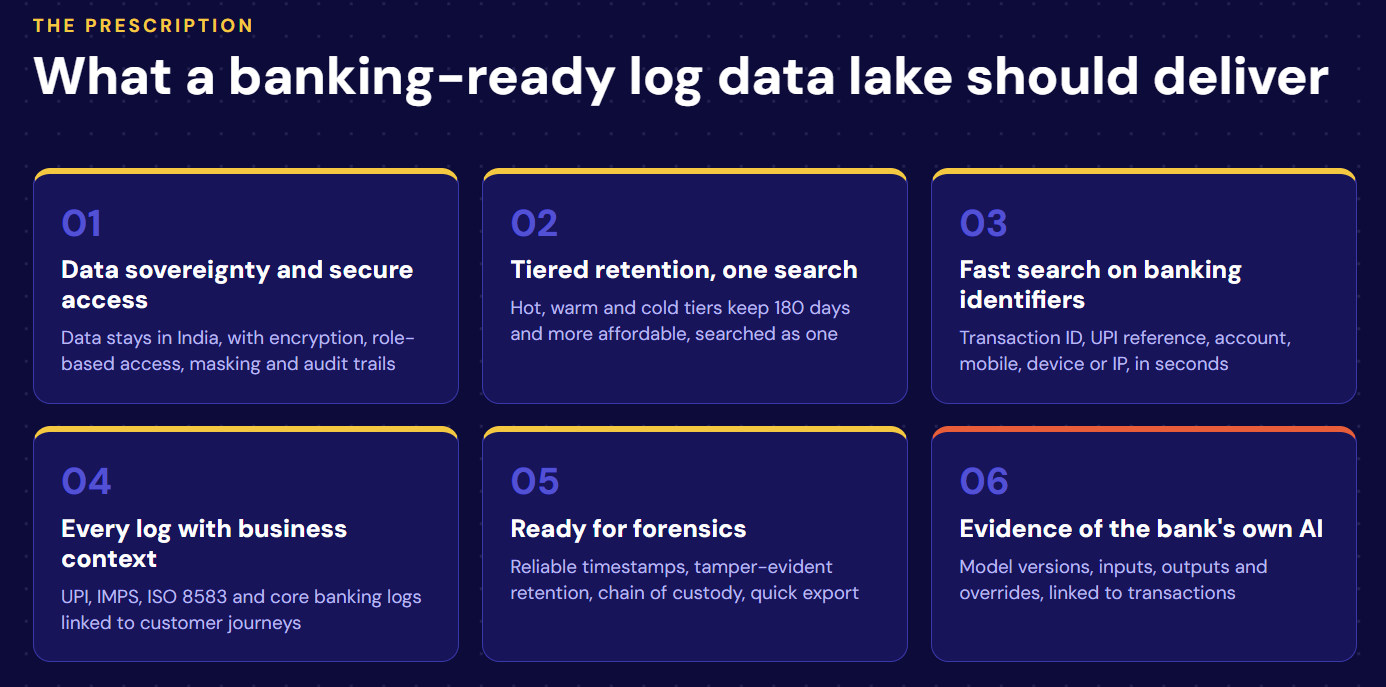
- Data sovereignty and secure access. Banking logs can contain highly sensitive customer and operational information. The architecture must support applicable data-residency requirements and deployment within appropriate on-premises or cloud environments. Encryption, role-based access, masking, and audit trails must protect sensitive information.
- Affordable, tiered retention with one search. Hot, warm and cold tiers keep 180 days and beyond affordable, and one query searches them all. Teams should be able to search across these tiers through a common interface, with transparent retrieval of archived records where necessary.
- Fast search using banking identifiers. Investigations rarely begin with a server name or infrastructure metric. They often begin with a transaction ID, UPI Reference Retrieval Number (RRN), customer ID, account number, device ID, mobile number or IP address. The platform must help teams find and connect related records across large datasets.
- Every log with business context. Payment, API and core banking records use different specialized formats. The data lake must parse relevant fields and link events to transactions and customer journeys. Collection gaps must also be visible.
- Reliable evidence for investigations. During a serious incident, investigators must establish what happened, when it happened and which systems or identities were involved. This requires reliable timestamps, tamper-evident retention, traceable access to evidence and documented chain-of-custody procedures. The platform should also support exporting relevant incident records, with integrity verification such as cryptographic hashes, without requiring weeks of manual extraction.
- Evidence of the bank's own AI. Model activity must connect to the decisions and transactions it affects, with sensitive information captured selectively.
Next steps for banks
Banks don’t need a major restructuring. They can begin with five steps.
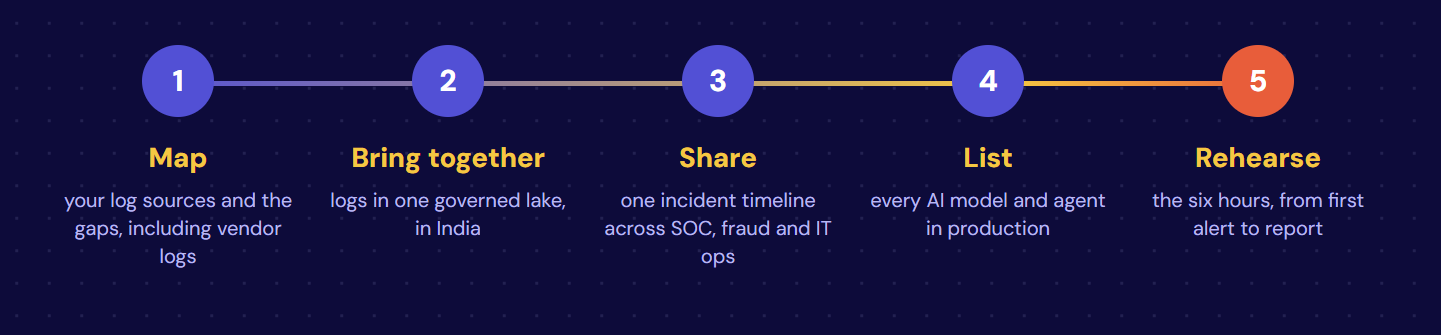
- Map your log sources and the gaps. Include application, transaction and vendor logs, not just security tools. Note where retention falls short of 180 days.
- Bring them into one governed lake, in India. Keep 180 days and beyond, searchable in seconds, at a cost that does not force you to drop sources.
- Give SOC, fraud, and IT operations one incident timeline. Look at every serious event through three lenses: security, fraud, and business impact.
- List every AI model and agent in production. Know what each can access, and test how you would switch it off without stopping the business.
- Rehearse the six hours. Run a drill from first alert to the CERT-In and RBI reports.
Then ask three questions at your next risk committee meeting:
- If we noticed a serious incident at 9 a.m., could we file a report, with evidence, by 3 p.m.?
- The last time OTP delivery or UPI success rates dropped, did anyone check whether it was an attack?
- If our fraud model started blocking genuine payments tomorrow, how quickly could we find out why?
If any answer to any of these is "not sure", that is where to start.
The next phase of banking cyber resilience will depend not only on how well banks protect their systems, but on how quickly they can connect the dots when something goes wrong.
Back to 9 a.m.
Consider how the response could unfold with this foundation in place.
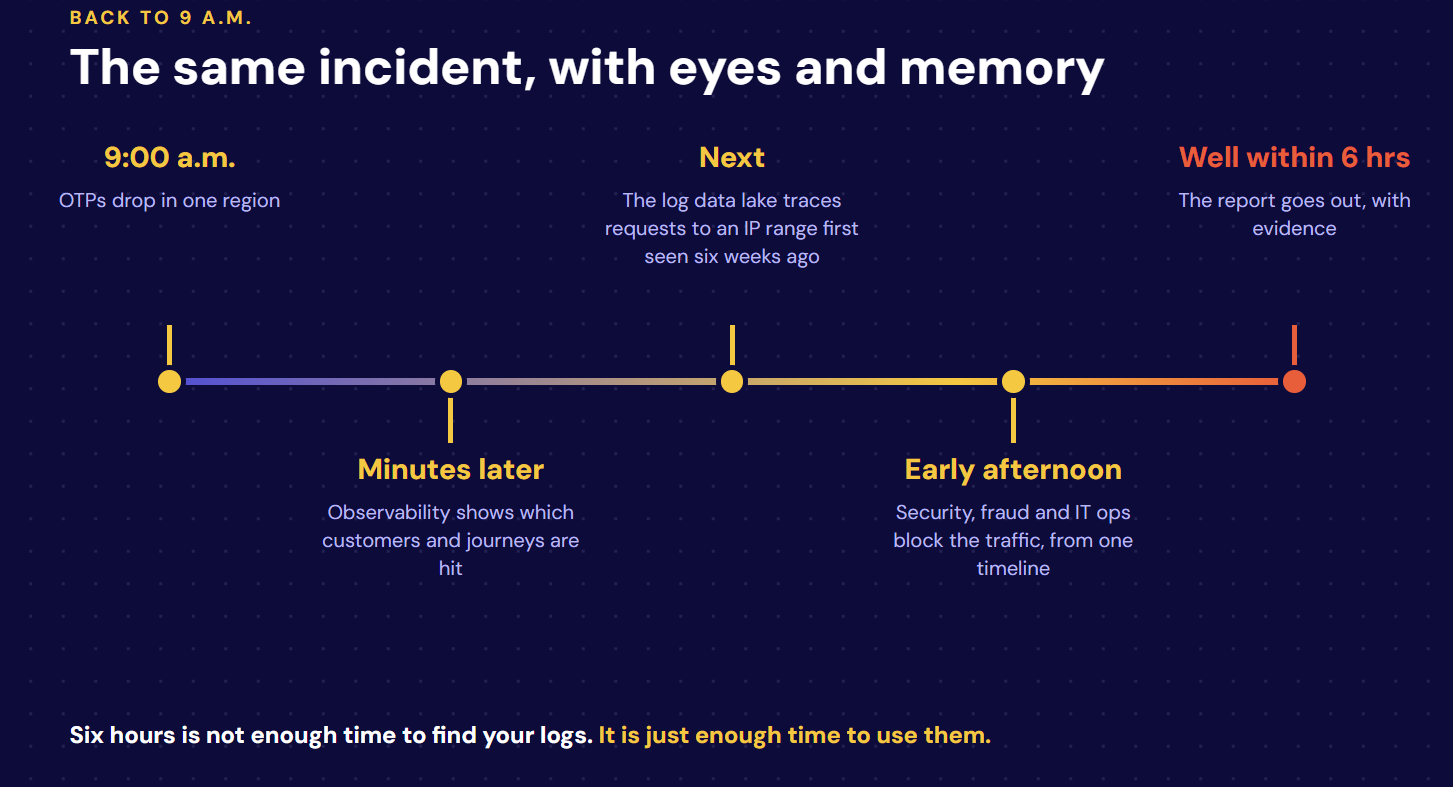
When OTP delivery falls, observability flags it within minutes and shows which customers and journeys are impacted. The log data lake compares current activity with earlier records. They find an unusual rise in requests and trace the associated accounts, sessions and transactions.
Security, fraud and operations review the same timeline. They block the suspicious traffic by early afternoon and send the report with evidence well within six hours.
How VuNet helps
VuNet's business observability platform, vuSmartMaps™, gives banks the eyes by showing live business impact across digital experience, transactions, applications and infrastructure. VuNet's Enterprise Data Lake adds the memory with governed, long-term, searchable history on the same data. It brings operational and business records together so teams can investigate activity across systems and time periods.
Together, they help banks connect a service disruption with the events behind it and the customers affected.
To learn more read our white papers, VuNet's Enterprise Data Lake Platform: An Introductory Perspective and Benchmarking the Performance of VuNet's Enterprise Data Lake.
Talk to the VuNet team and build the foundation before the next incident, not during it.