

A man walks into a bank to deposit a cheque. He speaks to three different desks, waits in a queue for an hour, before a teller finally accepts his form with the cheque, stamps the seal, and returns the counterfoil. A simple transaction such as this used to take anywhere between thirty minutes to an hour of a person’s life.
Digital banking changed this. It enabled customers to make transactions seamlessly, saving their time. Customers could check their balance, transfer funds, make payments, or activate a card without having to visit a branch. But as these transactions scaled up, it also became important that the customer experience is never broken regardless of the nature of the transaction.
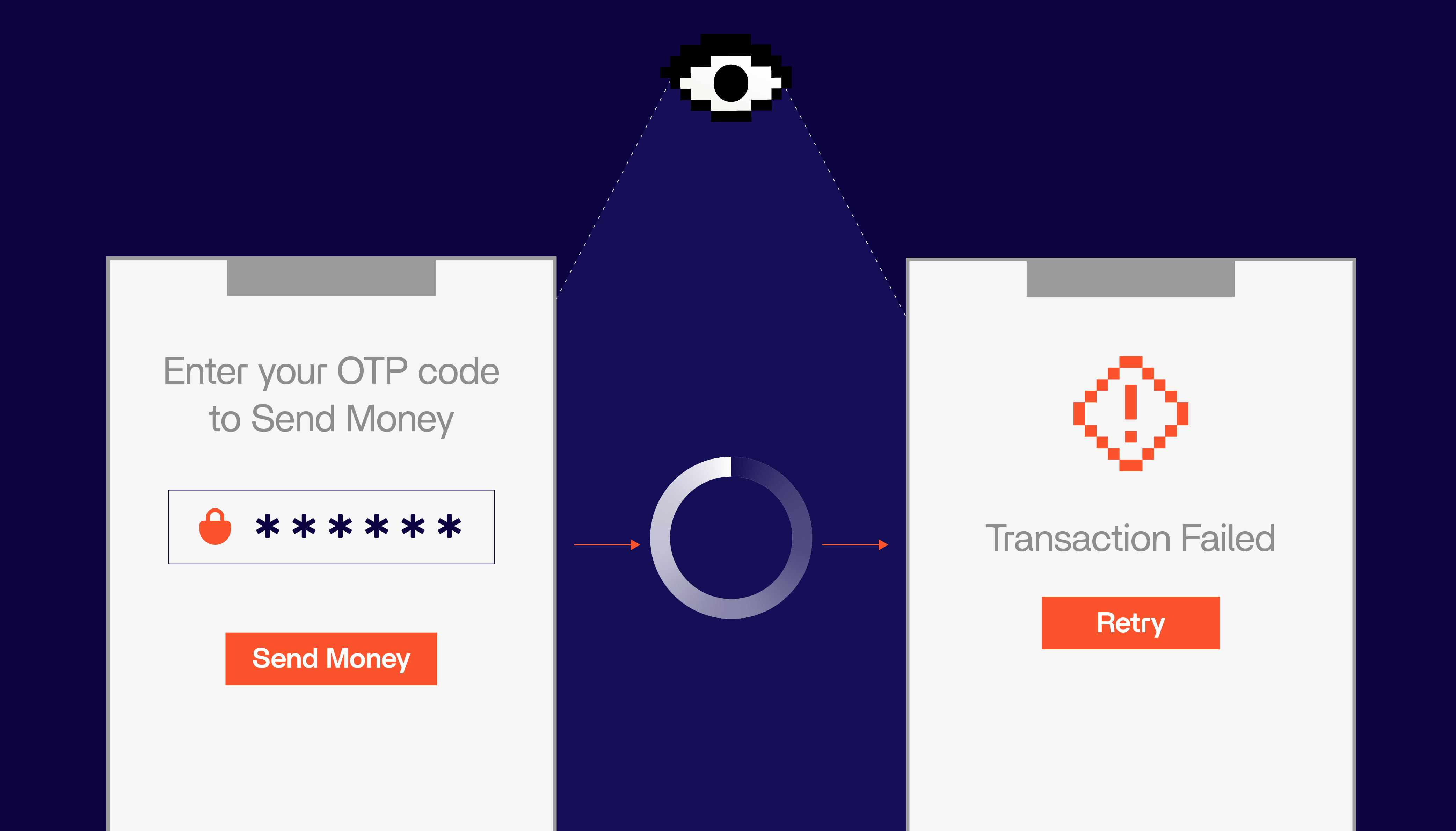
Customers rarely care if a failed transaction was caused by an unresponsive partner API or an underprovisioned infrastructure component. They simply see the failed outcome which breaks their experience.
For banks, however, identifying the cause is not always straightforward. Not every issue is an outage. They may be small, intermittent, device-specific or geography-specific issues which are difficult to reproduce, harder to diagnose, and often invisible until customer complaints begin.
This is where Digital Experience Monitoring (DEM) helps banks’ digital operations. It helps answer a simple question.
"Are customers able to complete what they came here to do?"
The answer comes from looking at digital journeys from multiple angles.
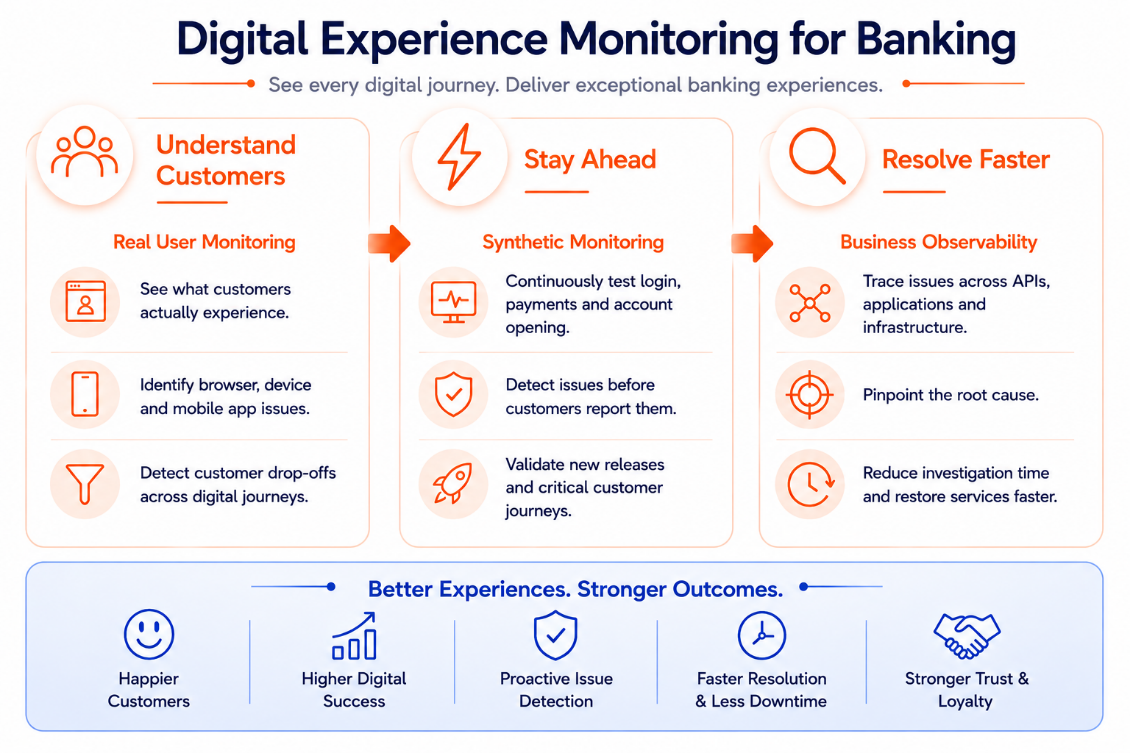
- Mobile Real User Monitoring (RUM) shows how customers experience banking apps in real time.
- Browser RUM provides the same visibility across internet banking portals.
- Synthetic Monitoring continuously tests critical journeys before customers encounter them.
- Finally, Business Observability which connects customer experience with everything happening behind the scenes, across browsers, mobile devices, APIs, applications, databases, infrastructure and third-party services. This context helps operations teams move from symptoms to root cause much faster.
Together, they help banks see problems early, understand why they happened and resolve them faster.
Digital Experience Across Banking Journeys
From login to payments, every digital journey matters. With rising customer expectations, a few seconds' delay on a payment screen or an unexpected crash during onboarding can quickly become a lost customer, a call to the contact centre or even a major escalation. Banks need to see digital journeys the way customers experience them and not how the systems report them.
Here's how Digital Experience Monitoring helps across some of the most common banking scenarios.
Scenario 1: Login and Authentication
- Customers struggle to log in after a new app release. Face ID works on some devices but fails on others.
- Mobile RUM immediately shows which devices, OS versions and app versions are affected.
- Synthetic Monitoring: Continuously validates login journeys across devices and networks before complaints begin.
Scenario 2: Customer Onboarding and KYC
- Customers start onboarding but abandon the journey during document upload or e-sign.
- MRUM & BRUM reveal exactly where customers dropped off and which devices or browsers were affected.
- Synthetic Monitoring validates the complete onboarding journey after every release and third-party integration change.
Scenario 3: Payment Confirmation Delays
- Customers tap Pay Now, but the confirmation page takes too long. Many retry the transaction and some end up paying twice.
- MRUM & BRUM show slow confirmation pages, retries and abandoned journeys.
- Business Observability traces the issue across payment gateways, APIs, databases and backend applications.
Scenario 4: OTP Delays
- The payment page loads, but the OTP arrives too late. Customers abandon the transaction.
- MRUM & BRUM show how long customers waited before dropping off.
- Business Observability identifies delays in notification services, SMS gateways or other backend dependencies.
Scenario 5: Browser-Specific Issues
- Everything works in Chrome, but Safari users cannot complete transactions.
- BRUM identifies browser-specific rendering issues, JavaScript errors and session behaviour.
- Synthetic Monitoring validates journeys across supported browsers.
Scenario 6: Mobile App Releases
- A new app version goes live. Customer ratings begin to drop.
- MRUM detects crashes, slow screens and device-specific issues.
- Synthetic Monitoring validates key journeys before and after every release.
Scenario 7: Third-Party Integration Changes
- A payment gateway, SMS provider or e-sign service changes an API endpoint.
- Synthetic Monitoring validates integrations continuously.
- MRUM & BRUM reveal customer impact, while Business Observability isolates whether the issue is internal or external.
Scenario 8: Network and ISP Performance
- Customers using one telecom provider complain about slow or failed transactions, while everyone else has a seamless experience.
- MRUM & BRUM identify network- or ISP-specific performance issues experienced by real users.
- Synthetic Monitoring validates critical journeys across multiple ISPs and network providers to quickly isolate network-related issues.
Scenario 9: Standing Instructions & Auto Payments
- Standing instructions fail overnight. EMIs and scheduled payments are missed until customers begin calling the bank.
- Synthetic Monitoring continuously validates scheduled payment journeys and SLA compliance, helping operations teams detect failures before customers are impacted.
Scenario 10: Forgot Password Workflow
- Customers attempting to reset their password get stuck after multiple attempts or abandon the process altogether, leading to increased support calls.
- MRUM & BRUM identify where customers drop off during the reset journey.
- Synthetic Monitoring continuously validates the complete password reset workflow across devices and channels.
Scenario 11: Cross-Channel Banking Journeys
- A customer starts a transaction on the mobile app but completes authentication or approval through internet banking. One step in the journey fails.
- Synthetic Monitoring continuously validates complete cross-channel customer journeys, while Business Observability traces the transaction across channels and backend systems.
What Digital Experience Monitoring Really Gives Banks
Digital Experience Monitoring isn't another dashboard. It's a way of seeing banking through the customer's eyes. It helps banks understand:
- Why do customers abandon journeys?
- Which devices or browsers are affected?
- Whether a release made things better or worse.
- Whether third-party services are impacting customer experience.
- Which journeys are slowing down before transaction failures increase.
- Where to start investigating before complaints become incidents.
Because in banking, customers don't remember whether your servers stayed up.
They remember whether they could complete their transaction.
Talk to the VuNet team to learn more about Digital Experience Monitoring